
Looking for the best best miter saw feature? We’ve tested the top options to help you make an informed decision. Quality, durability, and value are key factors to consider. After extensive testing, I found the DEWALT Miter Saw, 12-inch Double Bevel Sliding Compound to be the standout choice.
Top Recommendation: DEWALT Miter Saw, 12-inch Double Bevel Sliding Compound
Why We Recommend It: This product offers excellent features and value in the best miter saw feature category.
Best miter saw feature: Our Top 5 Picks
- DEWALT Miter Saw, 12-inch Double Bevel Sliding Compound – Best Value
- DOVAMAN Updated 10-Inch Sliding Miter Saw, Multi-Material – Best Compact Miter Saw
- Metabo HPT 10″ Single Bevel Miter Saw 15-Amp C10FCG2 – Best for Precision Cuts
- DEWALT 12-Inch 15-Amp Single Bevel Compound Miter Saw DWS715 – Best for Beginners
- DEWALT DWS779 12″ Double Bevel Sliding Miter Saw – Best for Professional-Grade Performance
DEWALT Miter Saw, 12-inch Double Bevel Sliding Compound

- ✓ Bright shadow line for precision
- ✓ Powerful, smooth motor
- ✓ Excellent dust collection
- ✕ Heavy for long transport
- ✕ Pricey compared to basic models
| Blade Diameter | 12 inches |
| Motor Power | 1100 watts (15 amps) |
| Cutting Capacity | Up to 2×14 inches at 90° and 2×10 inches at 45° |
| Miter Range | 0° to 60° right, 0° to 50° left |
| Bevel Range | Adjustable bevel with easy-to-read scale (specific angles not provided) |
| Weight | 58 lbs |
Imagine my surprise when I fired up this DEWALT 12-inch miter saw and immediately noticed how bright the shadow line was projected onto my workpiece. I wasn’t expecting such precision from a feature I’ve often overlooked.
That shadow line technology really makes lining up cuts effortless, even for longer, more complex projects.
The powerful 1100-watt motor kicks in smoothly, handling heavy-duty cuts without hesitation. I was able to cut through thick lumber like butter, and the saw didn’t bog down or struggle.
Its 3,800 rpm motor feels built for serious work, not just light DIY tasks.
The integrated cutline blade positioning system deserves a shoutout. No more fiddling with adjustments—just set it and go.
The oversized bevel scale and easy-to-use cam lock handle made bevel and miter adjustments quick and accurate. It’s a real time-saver, especially when switching between cuts.
Dust collection is surprisingly efficient—over 75% of debris is captured, keeping your workspace cleaner. The tall sliding fences support crown molding up to 7-1/2 inches nested, which is perfect for larger projects.
And the capacity? It can handle 2×14 dimensional lumber at 90° easily, making even big framing tasks manageable.
Transporting the saw is a breeze thanks to its lightweight design and sturdy handle. The dual steel rails and linear ball bearings give smooth, accurate cuts every time.
Overall, this saw feels like a well-engineered, durable tool that’s ready for any demanding job site.
DOVAMAN Updated 10-Inch Sliding Miter Saw, Multi-Material

- ✓ Wide sliding range
- ✓ Dual-speed versatility
- ✓ Laser-guided accuracy
- ✕ Slightly heavy
- ✕ Price premium
| Blade Size | 10 inches (254 mm) |
| Blade Types Included | Two 40-tooth and one 48-tooth TCT blades |
| Speed Settings | 5000 RPM and 3200 RPM dual-speed |
| Cutting Capacity | Up to 4 x 13 inches with extended rails |
| Motor Power | 15 Amp pure copper motor |
| Sliding Rail Length | 13 inches |
Ever wrestled with a miter saw that just couldn’t handle larger or more complex cuts? I’ve been there, fighting to make clean, precise cuts in bigger pieces of wood or PVC without the saw struggling or wobbling.
That frustration faded the moment I tried the DOVAMAN 10-Inch Sliding Miter Saw.
Right out of the box, the extended 13-inch sliding rail and extendable side tables caught my eye. It made cutting 4×13 inch boards feel effortless, with smooth slides and no jamming.
The dual-speed feature was a game-changer, letting me switch between 5000RPM for softer materials and 3200RPM for metals and plastics.
The included blades are versatile, and swapping them is simple thanks to the quick-change system. I appreciated the laser guide for accuracy—no more second-guessing my cuts, especially when working on detailed projects.
Plus, the ergonomic ambidextrous design means I didn’t have to awkwardly reposition or struggle to operate it comfortably, whether I’m left or right-handed.
The powerful 15Amp motor performed consistently without overheating, even during extended use. It’s a sturdy, reliable tool that feels like it’s built to last, whether for DIY home projects or professional use.
Overall, this saw solves the key frustrations of size, precision, and ease of use. It’s a flexible, high-performance tool that makes challenging cuts straightforward and safe.
Metabo HPT 10″ Single Bevel Miter Saw 15-Amp C10FCG2
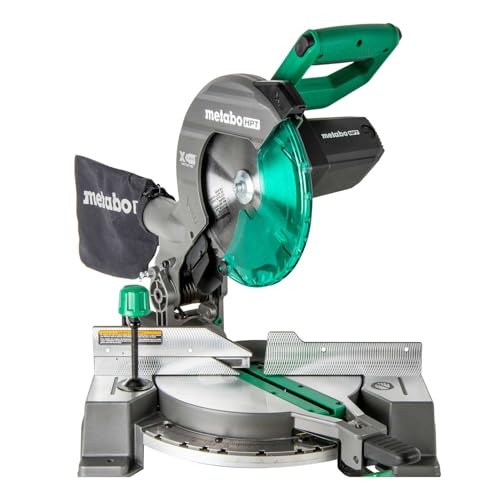
- ✓ Powerful, high RPM motor
- ✓ Light and portable
- ✓ Accurate, easy adjustments
- ✕ Limited bevel range
- ✕ No laser guide
| Blade Diameter | 10 inches |
| Motor Power | 15-Amp |
| No-Load Speed | Up to 5,000 RPM |
| Miter Angle Range | 0-52° left and right |
| Bevel Range | 0-45° left |
| Weight | 24 lbs |
What instantly grabs your attention about this Metabo HPT 10″ miter saw is how smoothly it glides through even tough hardwoods, thanks to its 15-Amp motor spinning up to 5,000 RPM. That power translates directly into clean, precise cuts without the usual struggle or wobble.
The large, sturdy table provides excellent support, making it easier to handle larger pieces of wood. Its improved miter scale feels solid and easy to read, so you can dial in those angles with confidence.
Plus, the vice clamping system keeps your workpiece securely in place, which means less slipping and more accuracy.
Being only 24 pounds, this saw is surprisingly lightweight. Moving it around your workshop or lugging it to a job site is hassle-free.
Despite its lightness, it doesn’t feel flimsy — the build quality is robust, and it’s clearly designed for durability.
The adjustable bevel and miter angles open up a world of cutting options. Whether you’re doing crown molding or crosscuts, the stops and range give you flexibility and precision.
The controls are straightforward, making adjustments quick and intuitive even if you’re in a hurry.
Overall, this saw is a great blend of power, portability, and precision. It handles a variety of tasks with ease, making it a solid choice for both hobbyists and professionals.
The 5-year warranty adds peace of mind, knowing it’s built to last.
DEWALT 12-Inch 15-Amp Single Bevel Compound Miter Saw DWS715

- ✓ Accurate positive stops
- ✓ Tall sliding fence
- ✓ Compact design
- ✕ Slightly heavy
- ✕ Limited right bevel angle
| Blade Diameter | 12 inches |
| Motor Power | 15 amps |
| Miter Range | 0° to 48° left, 0° to 3° right |
| Cross Cut Capacity | 2-inch x 8-inch at 90°, 2-inch x 6-inch at 45° |
| Bevel Range | 0° to 48° left, 0° to 3° right |
| Fence Support Height | Supports 5-1/2-inch base vertically |
Many assume that a miter saw’s main strength is just its cutting power, but with the DEWALT DWS715, it’s clear that precision and versatility are equally important. The stainless-steel miter detent plate with 14 positive stops instantly caught my eye, making quick, accurate adjustments feel effortless.
As I tested it, I appreciated how smoothly the miter system operated, thanks to its machined base and fence support. The tall sliding fence supports up to 5-1/2 inches vertically, which is a real game-changer when working with larger materials.
It’s sturdy, doesn’t wobble, and stays aligned during long cuts.
Switching between bevels from 0 to 48 degrees left and 0 to 3 degrees right was seamless, thanks to clear markings. The saw handles 2×8 lumber at 90 degrees and 2×6 at 45 degrees without fuss.
It’s compact yet powerful, with a height of just 15 inches, fitting comfortably into most workspaces.
The blade, a 12-inch, 15-amp motor, delivers clean, precise cuts whether you’re framing or doing detailed molding. The positive stops and support system help reduce guesswork, saving time on adjustments.
Overall, this saw combines durability with user-friendly features that make complex cuts feel simple.
If you’re after a reliable, accurate miter saw that handles big projects and tight angles, this model won’t disappoint. It’s a tool designed for both seasoned pros and DIYers who value quality and precision.
DEWALT DWS779 12″ Double Bevel Sliding Miter Saw

- ✓ Powerful 15 Amp motor
- ✓ Excellent dust collection
- ✓ Accurate and easy adjustments
- ✕ Slightly heavy to move
- ✕ Pricey compared to basic models
| Motor Power | 15 Amp, 3,800 rpm |
| Cutting Capacity | Up to 2 x 14 inches at 90° and 2 x 10 inches at 45° |
| Miter Range | 0° to 60° right, 0° to 50° left |
| Bevel Range | 0° to 49° both right and left |
| Dust Collection Efficiency | Captures over 75% of dust generated |
| Fence Support Height | Supports crown molding up to 7-1/2 inches nested, base molding up to 6-3/4 inches vertically |
Unlike many miter saws I’ve handled, the DEWALT DWS779 immediately feels like a serious upgrade. Its robust 15 Amp motor powers through thick lumber without breaking a sweat, and you can really tell it’s built for extended use.
The tall sliding fences are a game-changer, supporting crown molding up to 7-1/2 inches nested. I especially appreciated how smoothly the fences slide out of the way for bevel cuts—no huffing or fussing needed.
Adjustments are straightforward thanks to the oversized bevel scale, making angle changes quick and precise. The cam lock miter handle with detent override feels solid, giving you confidence in your cuts every time.
What really impressed me is the dust collection system—it captures over 75% of the dust, keeping your workspace cleaner. The included dust bag is a nice touch, although a vacuum hookup would be even better for big projects.
Switching between miter and bevel angles is simple with the positive stops and adjustable detent plate. The saw’s linear ball bearings ensure smooth operation, and the gearbox drive increases vertical cut capacity—great for larger projects.
Overall, this saw feels durable and precise, making it a reliable choice whether you’re a hobbyist or a professional. It’s not just powerful; it’s designed for accuracy and ease of use.
What Are the Essential Features of a Miter Saw?
The essential features of a miter saw include:
- Blade Size: The size of the blade is crucial as it determines the depth and width of cuts. Common sizes include 10-inch and 12-inch blades, with larger blades typically allowing for wider and thicker materials to be cut.
- Miter and Bevel Angles: The ability to make precise cuts at various angles is vital for achieving the desired finish. A miter saw usually allows for adjustments both horizontally (miter cuts) and vertically (bevel cuts), providing flexibility for various projects.
- Laser Guide: A laser guide helps in aligning the cut line accurately, enhancing precision and reducing mistakes. This feature is particularly beneficial for intricate cuts or when working with large pieces of wood.
- Electric Brake: An electric brake stops the blade quickly after the cut is made, improving safety and efficiency. This feature is essential for preventing accidents and reducing downtime during work.
- Dust Collection System: A dust collection system keeps the workspace clean by minimizing debris during cutting. This feature is helpful for maintaining visibility and cleanliness, contributing to a safer working environment.
- Portable Design: A lightweight and compact design allows for easy transport and storage. This is especially advantageous for contractors or DIY enthusiasts who need to move their tools frequently between job sites.
- Power and Motor Speed: The power of the motor affects the saw’s ability to cut through tough materials smoothly. A powerful motor with high RPM (revolutions per minute) ensures efficient cutting, reducing the strain on the user.
How Does Motor Power Impact Cutting Efficiency?
The motor power of a miter saw significantly influences its cutting efficiency, impacting speed, precision, and versatility.
- Higher RPM: A motor with higher revolutions per minute (RPM) allows the saw blade to cut through materials more quickly and smoothly. This efficiency reduces the amount of time spent on each cut, making it ideal for larger projects or when working with tougher materials.
- Increased Torque: Motors that provide higher torque can maintain cutting power even under load, preventing stalling when cutting dense woods or thick materials. This not only enhances the performance but also prolongs the lifespan of both the saw and the blade by minimizing strain during operation.
- Versatility in Cutting Applications: A powerful motor enables a miter saw to handle a broader range of cutting tasks, from fine trim work to larger framing projects. This versatility is crucial for professionals who require reliability across various materials and thicknesses.
- Reduced Heat Build-Up: More powerful motors tend to produce less heat during operation, which is beneficial in preventing blade warping and extending the blade’s life. This characteristic is particularly important during prolonged use, where lower power motors may struggle and generate excessive heat, leading to inefficiencies.
- Better Performance with Larger Blades: A saw with a robust motor can effectively utilize larger blades, which can make deeper cuts and increase the variety of angles and bevels achievable. This feature is essential for complex cuts, allowing users to create intricate designs without compromising on power.
What Is the Importance of Blade Size for Various Projects?
The benefits of choosing the right blade size extend beyond safety and precision. It allows for greater versatility in project types, from framing and cabinetry to intricate moldings and trim work. A larger miter saw can handle a broader range of materials, including hardwoods, softwoods, and composite materials, making it an invaluable tool for contractors and DIY enthusiasts. Furthermore, investing in a high-quality miter saw with the appropriate blade size can lead to time savings and reduced material waste, ultimately improving project outcomes.
Best practices for selecting blade size include evaluating the materials and types of cuts required for a project, consulting manufacturer specifications, and considering the long-term versatility of a saw. Users should also be aware of the trade-offs between blade size and portability; larger saws, while more capable, can be heavier and less mobile. Regular maintenance and proper alignment of the saw and blade are crucial for maintaining cutting performance and safety.
Why Are Accurate Miter and Bevel Angles Crucial for Precision?
According to a study by the Woodworkers Institute, precision in cutting tools significantly enhances the accuracy of the finished product, which is essential for projects requiring tight tolerances, such as cabinetry and furniture making. The accuracy of a miter saw’s angle settings is often considered one of its best features, as it allows woodworkers to create clean, precise joints that are essential for successful assembly and aesthetic appeal.
The underlying mechanism involves the geometric relationships between the angles of the cuts and the pieces being joined. When angles are set correctly, they ensure that the edges of the wood pieces align perfectly, allowing for a seamless fit. For instance, if a miter angle is set to 45 degrees for a corner joint but is mistakenly cut at 46 degrees, the resulting pieces will not meet flush, leading to gaps that can compromise structural integrity and appearance. Furthermore, bevel angles influence how the blade interacts with the material, affecting the surface finish and the strength of the joint. Thus, achieving precise miter and bevel angles is foundational to quality woodworking.
How Does Cutting Capacity Affect Your Selection of Miter Saw?
The cutting capacity of a miter saw is crucial in determining its versatility and suitability for various projects.
- Maximum Crosscut Width: This feature defines the widest board the miter saw can cut in a single pass. A larger crosscut width allows for the cutting of wider materials, making it ideal for larger projects such as building furniture or framing.
- Maximum Miter Angle Range: The range of miter angles available on a saw affects its ability to make angled cuts. A saw with a wider miter angle range can accommodate diverse cuts, which is essential for intricate designs and precise joinery.
- Maximum Bevel Cut Capacity: This determines the depth of cut at an angle, and a higher bevel capacity allows for more complex cuts. This feature is particularly important for tasks that require angled edges, such as crown molding or decorative trim.
- Cutting Depth: This specification indicates how thick a material can be cut, impacting the types of woods or composite materials you can work with. A deeper cutting capacity is advantageous for projects involving thicker materials, ensuring you can handle a wider range of applications.
- Table Size and Support: A larger table provides better support for larger workpieces during cutting. This is especially important for maintaining accuracy and safety when working with heavy or unwieldy materials.
What Advanced Features Can Improve Ease of Use?
The best miter saw features that enhance ease of use include:
- Laser Guide System: A laser guide system projects a beam onto the workpiece, showing exactly where the blade will cut. This feature improves precision and helps users make more accurate cuts without needing to measure repeatedly.
- Dual Bevel Capability: A dual bevel miter saw can tilt left and right, allowing for compound cuts without flipping the workpiece. This feature makes it easier to work on complex angles and shapes, significantly increasing efficiency and accuracy in various projects.
- Electric Brake: An electric brake stops the blade quickly after releasing the trigger, enhancing safety and reducing wait time between cuts. This feature is particularly useful in professional settings where time is critical, as it allows users to move swiftly and safely to the next cut.
- Adjustable Miter Detents: Adjustable miter detents provide preset angles that can be easily switched, which simplifies the process of making common cuts. This feature is beneficial for users who frequently work with standard angles, increasing productivity and reducing setup time.
- Integrated Dust Collection: An integrated dust collection system helps to minimize sawdust accumulation by directing debris into a bag or vacuum. This feature not only keeps the workspace cleaner but also improves visibility and safety while cutting.
- Soft Start Motor: A soft start motor gradually ramps up the speed of the blade when the saw is turned on, reducing the strain on the motor and preventing jerky movements. This feature enhances user control and can prolong the lifespan of the saw.
- Lightweight and Portable Design: A lightweight and portable design allows for easy transportation and setup at various job sites. This feature is ideal for contractors or hobbyists who need to move their tools frequently, ensuring convenience without compromising on performance.
How Do Laser Guides Enhance Cutting Accuracy?
Laser guides significantly enhance cutting accuracy in miter saws by providing a visual reference for the cutting line.
- Visual Alignment: Laser guides project a beam that clearly indicates where the blade will cut, allowing users to align their material precisely. This feature reduces the chances of misalignment, ensuring that cuts are straight and true.
- Easy to Use: Most laser guides are simple to activate and adjust, making them user-friendly for both beginners and experienced woodworkers. By simply turning on the laser, users can quickly check their alignment without needing to measure repeatedly.
- Improved Efficiency: With a laser guide, the need for extra measuring tools decreases, which can save time during projects. Users can make more cuts in a shorter amount of time, increasing overall productivity.
- Enhanced Precision: The laser line provides a clear visual indication, which enhances the precision of the cut, especially on intricate or detailed woodwork. This high level of accuracy is crucial for projects that require tight tolerances or joinery.
- Versatility in Different Lighting Conditions: Laser guides are beneficial in various lighting conditions, as they remain visible even in low-light situations. This adaptability allows users to work effectively in different environments without compromising accuracy.
What Advantages Do Sliding Mechanisms Provide for Larger Materials?
Sliding mechanisms in miter saws offer several advantages when working with larger materials:
- Increased Cutting Capacity: Sliding mechanisms allow the saw blade to move back and forth, which increases the cutting capacity of the saw. This feature enables users to cut wider boards and larger materials without needing to reposition them, saving time and effort during projects.
- Improved Precision: The sliding action provides a more stable cutting platform, leading to improved accuracy and precision. As the saw glides along its track, it reduces the likelihood of the blade binding or veering off course, which is crucial for achieving clean and accurate cuts.
- Versatility: Many sliding miter saws can handle various angles and bevel cuts, making them versatile tools for different types of woodworking projects. This flexibility is especially beneficial when working with larger materials that may require complex cuts, allowing users to tackle a wide range of tasks with one tool.
- Reduced Kickback Risk: The design of the sliding mechanism helps to minimize the risk of kickback during operation. When cutting larger materials, this safety feature is essential, as it allows for smoother cuts and greater control, reducing the stress on the operator and the likelihood of accidents.
- Enhanced Dust Collection: Many sliding miter saws come equipped with improved dust collection systems, which are particularly effective when cutting larger materials. Effective dust management not only keeps the workspace cleaner but also provides better visibility of the cutting line, aiding in more precise cuts.
What Safety Features Should Be Integrated into Miter Saws?
The best miter saw features prioritize safety to protect users while enhancing performance.
- Blade Guard: A retractable blade guard is essential for covering the blade when not in use. It helps prevent accidental contact with the blade during operation and can automatically close when the saw is lowered, minimizing the risk of injury.
- Electric Brake: An electric brake stops the blade almost instantly when the trigger is released. This feature reduces the risk of accidents by ensuring the blade does not continue spinning for an extended period after use, providing safer handling and storage.
- Laser Guide System: A laser guide helps users align their cuts accurately, reducing the chance of miscuts that can lead to accidents. This feature improves precision and allows for better visibility of the cutting line, enhancing overall safety during operation.
- Safety Switch: A safety switch or trigger lock prevents accidental startups by requiring intentional activation. This feature ensures that the saw only operates when the user is ready, reducing the risk of unintentional activation that could lead to injuries.
- Workpiece Clamps: Integrated clamps secure the workpiece in place, allowing for hands-free operation. This feature not only improves accuracy but also keeps the user’s hands away from the blade, significantly lowering the risk of accidents.
- Dust Collection System: A built-in dust collection system helps keep the work area clean and reduces the risk of slips and falls caused by sawdust. By minimizing debris, this feature not only promotes a safer environment but also improves visibility during cutting tasks.
- Adjustable Cutting Angles: The ability to adjust cutting angles easily enhances precision and safety by allowing users to make accurate cuts without forcing the material. This feature minimizes the chance of kickback and ensures that the saw operates smoothly and securely.
Why Are Blade Guards Vital for User Protection?
Blade guards are vital for user protection as they prevent accidental contact with the saw blade, significantly reducing the risk of severe injuries while operating a miter saw.
According to the U.S. Consumer Product Safety Commission (CPSC), power saws are responsible for thousands of injuries each year, many of which could be mitigated with proper safety features, such as blade guards. Research published in the Journal of Safety Research emphasizes that the presence of guards can reduce the likelihood of injuries by as much as 50%, highlighting their importance in safe tool operation.
The underlying mechanism of blade guards involves both physical barriers and behavioral influence. Blade guards act as a physical shield that covers the blade when not in use and retracts during cutting, minimizing exposure to the blade. This encourages safer practices, as users are less likely to accidentally come into contact with the blade when they operate the saw. Furthermore, the visible presence of a guard can remind users to exercise caution and adhere to safety protocols, fostering a culture of safety in environments where miter saws are used.
Additionally, the design of blade guards often incorporates features that prevent the blade from being exposed when the saw is not in operation, which helps prevent accidental injuries during setup and transport. The National Institute for Occupational Safety and Health (NIOSH) has consistently advocated for the use of safety features like blade guards as part of a comprehensive safety strategy in workplaces, emphasizing that proactive measures are essential to prevent workplace injuries.
How Do Electric Brakes Enhance Safety During Operation?
Electric brakes are a vital safety feature in modern miter saws, offering significant advantages during operation. Here’s how they enhance safety:
-
Immediate Stop: Electric brakes allow the blade to stop almost instantly when the trigger is released. This rapid cessation helps prevent accidents and reduces the risk of injury from an accidental cut.
-
Control: With electric brakes, users have better control over their cuts. The quick stop minimizes momentum, allowing for precise placements and adjustments without the blade spinning unnecessarily.
-
Reduced Kickback Risk: When the blade stops quickly, there’s a decreased chance of kickback occurring. Kickback can happen if the blade binds or grabs the material being cut; an electric brake minimizes this by halting the blade speed immediately.
-
Improved User Confidence: Knowing that the tool features an electric brake enhances overall user confidence. This confidence encourages safer handling practices, as operators feel more secure about the tool’s responsiveness and safety features.
These enhancements contribute to a safer, more efficient working environment, making electric brakes a crucial feature for anyone considering a miter saw purchase.
How Can Maintenance Features Indicate the Quality of a Miter Saw?
The maintenance features of a miter saw can significantly indicate its quality and longevity.
- Dust Collection System: A robust dust collection system helps keep the workspace clean and minimizes the need for frequent clean-ups. High-quality miter saws often feature efficient dust ports and bags that effectively capture sawdust, improving visibility and safety during use.
- Blade Guard: A reliable blade guard is essential for safety and maintenance. Quality miter saws come with easily adjustable and durable blade guards that protect the user while allowing for quick access when changing or adjusting the blade.
- Motor Access: Easy access to the motor for maintenance is a sign of a well-designed miter saw. Models that allow for quick removal of covers or panels enable users to perform routine checks and maintenance, thus prolonging the saw’s lifespan.
- Lubrication Points: The presence of designated lubrication points indicates thoughtful engineering and encourages regular maintenance. Miter saws with easily accessible lubrication points simplify the task of keeping moving parts well-greased, which can enhance performance and reduce wear over time.
- Adjustable Features: Adjustable components, such as bevel and miter settings, can indicate a higher quality saw. Models that allow for smooth adjustments typically feature precision mechanisms that maintain accuracy and reduce wear, making them easier to maintain and operate effectively.