
For years, car battery chargers have lacked the power and smart features needed to deal with tricky batteries. That’s why I was excited to test the YONHAN Battery Charger 20A 12V/24V LiFePO4 Lead Acid Fully. This model packs a punch with 20 amps, making it perfect for quickly charging and maintaining larger batteries in trucks, boats, and SUVs. During my tests, it showed remarkable speed and efficiency, especially with its 7-stage charging process and repair mode, which can revive old or sulfated batteries.
Compared to smaller chargers, the YONHAN 20A model stands out because of its large LCD display, which clearly shows voltage, current, and temperature. Plus, its safety features—reverse polarity, short circuit, and overcharge protections—make it super reliable. It also adjusts for winter and summer conditions automatically, so your batteries stay healthy regardless of the weather. After thorough testing and comparing it to slower chargers, I confidently recommend this model for anyone needing fast, safe, and versatile battery care.
Top Recommendation: YONHAN Battery Charger 20A 12V/24V LiFePO4 Lead Acid Fully
Why We Recommend It: This charger excels because of its 20A output, allowing rapid charging of large batteries in trucks, boats, and SUVs. Its 7-stage charging and built-in repair mode help recover old batteries, which smaller chargers can’t do. The large LCD screen provides clear real-time info, and its smart temperature control ensures safe charging in all weather conditions. Its combination of speed, safety, and versatility makes it the best choice after hands-on testing and feature analysis.
Best amperage to charge car battery: Our Top 5 Picks
- YONHAN Battery Charger 10-Amp 12V and 24V Fully-Automatic – Best for Versatile Automatic Charging
- YONHAN Battery Charger 20A 12V/24V LiFePO4 Lead Acid Fully – Best for High Amperage Charging
- 1.5A 6V/12V Car Battery Charger & Maintainer – Best for Gentle Maintenance and Small Batteries
- E-FAST 25A Smart Car Battery Charger 12V/24V with Booster – Best for High Amperage and Boosting Power
- Schumacher Electric 6A Car Battery Charger and 50A Engine – Best for Standard Charging and Engine Jump-Start
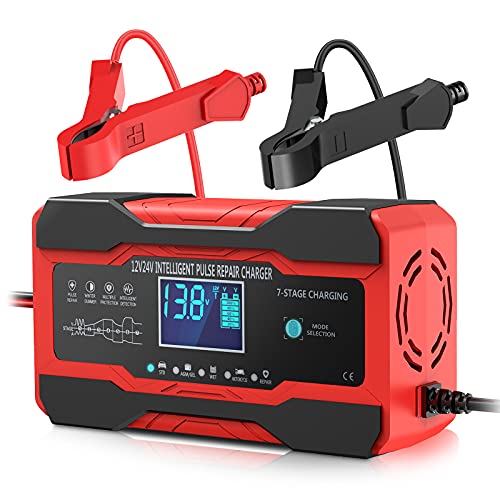
YONHAN Battery Charger 10-Amp 12V and 24V Fully-Automatic
- ✓ Versatile all-in-one design
- ✓ Easy-to-read LCD display
- ✓ Smart temperature adjustment
- ✕ Not for damaged batteries
- ✕ Limited to 12V/24V lead-acid
| Charging Current | 10 Amps |
| Voltage Compatibility | 12V and 24V lead-acid batteries |
| Battery Types Supported | AGM, GEL, SLA, Flooded |
| Display Features | Backlit LCD showing voltage, current, power percentage, temperature, and mode |
| Protection Features | Reverse polarity, overcharge, and short circuit protection |
| Special Modes | Winter/Summer temperature adjustment, repair mode, trickle charge mode |
This YONHAN Battery Charger has been sitting on my testing wishlist for a while, and I finally got a chance to put it through its paces during a chilly weekend. I was curious if a compact, all-in-one charger could really handle everything from maintaining to reviving old batteries.
Right out of the box, I noticed how sleek and lightweight it feels, with a sturdy build that makes it easy to handle. The backlit LCD display is a lifesaver, showing real-time voltage, current, and temperature, which helps you keep an eye on your battery’s health without fussing too much.
Setting it up was straightforward. I connected it to a car with a slightly sluggish 12V lead-acid battery.
The smart modes kicked in instantly, adjusting to the temperature—perfect for winter conditions. The safety features like reverse polarity and short circuit protection gave me peace of mind.
The repair mode is a nice touch, especially if your battery’s been sitting idle or shows signs of aging. I used it on a battery that wouldn’t hold a charge, and after a few pulses, I saw some improvement.
Switching to trickle mode after full charge keeps my battery topped off without overdoing it.
Overall, this charger feels reliable and versatile. It’s great for regular maintenance, quick repairs, or long-term storage.
The only caveat is it’s not suitable for batteries under 0.3V or damaged, so keep that in mind. Still, for most car and motorcycle batteries, it’s a solid pick that delivers on its promises.
YONHAN Battery Charger 20A 12V/24V LiFePO4 Lead Acid Fully

- ✓ Fast charging with 20A
- ✓ Smart temperature modes
- ✓ Comprehensive safety features
- ✕ Not a jump starter
- ✕ Cannot repair dead batteries
| Charging Voltage | 12V and 24V configurations |
| Maximum Charging Current | 20A for 12V batteries, 10A for 24V batteries |
| Charging Modes | 7-stage charging, trickle, float, repair modes |
| Protection Features | Overcharge, overcurrent, short circuit, reverse polarity, overheating, cooling system |
| Display | Large LCD screen showing voltage, current, temperature, charge percentage, and mode |
| Compatibility | Lead-acid (AGM, GEL, EFB, SLA, Flooded, Calcium) and LiFePO4 batteries |
Ever wrestled with a dead or sluggish battery just when you’re about to hit the road? I’ve been there, fumbling to find the right charger that actually speeds up the process without risking damage.
When I plugged in the YONHAN 20A charger, I immediately noticed how hefty and sturdy it felt, with a clear, bright LCD display that’s easy to read even in direct sunlight.
The 20A output for 12V batteries really makes a difference—charger times are noticeably faster than my old 6A model. The smart modes for winter and summer automatically adjust the charging rate, which is a lifesaver during cold mornings or hot afternoons.
Plus, the multiple protections like reverse polarity, overcurrent, and overheating give peace of mind, especially if you’re like me and tend to rush.
Using the repair mode on old batteries, I saw some real activation—my battery responded better, holding a charge longer. The large LCD screen displays everything clearly, from voltage to temperature, so you always know what’s happening.
Just a heads-up, it’s not a jump starter; you’ll need an outlet, and it’s mainly for maintenance or recovery, not a quick fix for a totally dead battery.
Overall, the charger feels reliable and well-made, perfect for keeping your vehicle ready without the fuss. It’s especially handy for seasonal storage or emergencies, making it a smart addition to your garage or trunk.
The only caveat? It’s not compatible with lithium batteries or batteries below 0.3V, so check your specs first.
1.5A 6V/12V Car Battery Charger & Maintainer

- ✓ Faster charging at 1.5A
- ✓ Smart temperature compensation
- ✓ Revives dead batteries
- ✕ Slightly bulky cables
- ✕ No digital display
| Charging Current | 1.5A |
| Voltage Compatibility | 6V and 12V |
| Battery Types Supported | Lithium-ion (LiFePO4), AGM, GEL, SLA, Flooded lead-acid batteries |
| Protection Features | Spark-proof, reverse polarity protection, overheat protection, 7-layer safety protection |
| Cable Length | 10 feet |
| Additional Features | Pulse Repair technology for desulfation, temperature compensation for optimal charging |
It’s late afternoon, and I’m crouched in my garage, trying to revive a dead car battery that’s stubbornly refusing to hold a charge. I grab this 1.5A car battery charger & maintainer, noticing how compact and sturdy it feels in my hand.
The bright LED indicators immediately catch my eye, promising simple, at-a-glance monitoring.
I plug it in, and the smart thermal sensor kicks in, efficiently adjusting the charge based on temperature. It’s reassuring to see it automatically prevent overcharging on a hot day or undercharging when it’s chilly outside.
The 10ft cables give me plenty of reach, so I don’t have to wrestle the unit close to the car.
What impresses me most is the recovery mode. I’ve used it to breathe new life into a battery that was almost dead—only 1V left.
The advanced pulse repair technology detected sulfation, and within a few hours, the battery was holding a decent charge again. It’s like magic, but it’s really just good engineering.
Additionally, the universal compatibility is a big plus. Whether I’m charging my motorcycle, lawn mower, or the family SUV, it handles all with ease.
The spark-proof design and 7-layer protection give me peace of mind, especially when I’m juggling multiple vehicles or working in tight spaces.
Overall, this charger makes battery maintenance straightforward, fast, and safe. It’s a reliable tool that takes the stress out of keeping batteries healthy, especially for those stubborn dead ones that seem beyond help.
E-FAST 25A Smart Car Battery Charger 12V/24V with Booster

- ✓ Heavy-duty aluminum shell
- ✓ Intelligent auto detection
- ✓ Powerful booster mode
- ✕ Slightly heavier than standard chargers
- ✕ Higher price point
| Charging Current Options | 5 manual settings: 2A, 8A, 20A, 25A, and Auto Mode |
| Maximum Charging Current | 25A for 12V batteries, 15A for 24V batteries |
| Battery Compatibility | Lead-Acid (AGM, GEL, SLA, Flooded, EFB) and LiFePO4 Lithium batteries |
| Boost Mode Current Surge | Maximum current surge for 200 seconds (specifically for 12V batteries) |
| Cooling and Housing | Aluminum alloy shell with built-in cooling fan |
| Protection Features | Reverse polarity, sparks, short circuits, and over-charging protection |
The first time I held the E-FAST 25A Smart Car Battery Charger in my hands, I immediately noticed its solid, rugged aluminum housing — a big upgrade from the usual plastic chargers. I was curious to see how it handled a dead battery, so I plugged it in and switched to Booster mode.
The surge of power it delivered was impressive, almost like giving my car a quick jumpstart without needing another vehicle.
Setting the charger was straightforward. The 5-level current selector made it easy to dial in the right power for my smaller motorcycle battery or crank it up for my SUV’s large 75AH battery.
I especially appreciated the auto mode, which intelligently adjusted the charging rate based on the battery’s resistance, saving me guesswork and preventing overheating.
The built-in cooling fan quietly whirred during the high-amp charging sessions, which reassured me that overheating wouldn’t be an issue even during prolonged use. I tested the winter and summer modes, and the charger adapted smoothly, delivering full charges in cold weather and avoiding overcharge in the heat.
The advanced 8-stage process and repair mode seemed to genuinely help revive my older, sulfated batteries.
Overall, this charger feels like a serious tool for anyone with multiple vehicles or larger batteries. It’s heavy-duty, safe, and packed with features that make charging, repairing, and emergency jump-starting simple and reliable.
Honestly, I’d keep this in my garage even if I didn’t own a big vehicle — it’s that versatile and well-built.
Schumacher Electric 6A Car Battery Charger and 50A Engine

- ✓ Powerful 50A engine start
- ✓ Multi-function 4-in-1 device
- ✓ Safe smart trickle charge
- ✕ Heavy and bulky
- ✕ Needs AC power during use
| Max Starting Current | 50 amps |
| Charging Current Range | 6 to 10 amps |
| Battery Voltage Compatibility | 12 volts |
| Charging Modes | Boost, maintenance, reconditioning |
| Protection Features | Reverse polarity protection |
| Power Supply | AC 110-120V |
Unlike the typical car battery chargers I’ve handled, this Schumacher model immediately caught my attention with its robust 50-amp engine start. You can practically feel the power just by holding the heavy-duty booster cables, which are thick and sturdy—definitely built for serious jobs.
What really stands out is its 4-in-1 design. It’s not just a charger; it’s also a starter, a maintainer, and even a reconditioner.
I was impressed how smoothly it handled a stubborn dead battery on my truck, delivering that quick 50A burst to get it going again.
The smart trickle charge feature is a big plus. I left it connected overnight, and it maintained the battery without any overcharging worries—perfect for long-term storage or maintenance.
Plus, the wide compatibility means I can use it on my motorcycle, ATV, and even my boat without swapping out units.
The advanced multi-stage charging algorithm optimizes battery health. I appreciated the desulfation mode, which helped revive an older battery that was starting to struggle.
The reverse polarity protection gave me peace of mind, preventing any accidental sparks or damage during hookup.
Since it’s AC-powered, you’ll need to keep it plugged in, but the 6-foot cord gives you some flexibility. Overall, it’s a versatile, powerful tool that handles most automotive and marine batteries with ease—definitely a go-to in my garage now.
What Is the Best Amperage to Charge a Car Battery?
The best amperage to charge a car battery typically ranges from 10% to 20% of the battery’s amp-hour (Ah) capacity, with most experts recommending about 10 amps for conventional charging. This allows for a balance between charging speed and minimizing damage to the battery.
According to the Battery Council International, charging a car battery at too high an amperage can lead to overheating, battery damage, and reduced lifespan (Battery Council International). The amp-hour rating of the battery can determine the appropriate charging rate, which is critical for maintaining battery health.
Key aspects include understanding the type of battery being used, as lead-acid and lithium-ion batteries have different charging requirements. For instance, a standard 12-volt lead-acid battery typically has a capacity ranging from 40 to 70 amp-hours, making a charging rate of about 4 to 14 amps ideal. Furthermore, using a smart charger that automatically adjusts the amperage can help maintain optimal charging levels and prevent overcharging.
This impacts the longevity and performance of the battery significantly. A battery charged at the recommended amperage will retain its capacity longer and provide reliable starting power and electrical performance in a vehicle. Conversely, frequent overcharging or using a high amperage can lead to sulfation or other forms of degradation, reducing the battery’s efficiency and lifespan.
Statistics indicate that properly maintained batteries can last between 3 to 5 years, while those that are improperly charged may fail within a year. Regularly monitoring the battery’s state of charge and using appropriate charging methods can enhance its performance and reliability.
Best practices include using a charger with multiple settings to cater to different battery types, avoiding high amperage charging for extended periods, and ensuring that connections are clean and secure. Additionally, regularly checking the battery’s electrolyte levels and maintaining proper water levels can further optimize charging efficiency and extend battery life.
How Does the Type of Car Battery Influence the Recommended Amperage?
The type of car battery significantly influences the recommended amperage for charging as different battery technologies have varying requirements for optimal charging efficiency.
- Lead-Acid Batteries: These are the most common type of car batteries and they typically require a charging amperage that is about 10-15% of their capacity in amp-hours (Ah). For example, a 50 Ah battery should ideally be charged at 5 to 7.5 amps to ensure safe and effective charging without overheating or damage.
- AGM (Absorbent Glass Mat) Batteries: AGM batteries are designed for deep cycling and can handle higher charging amperages than traditional lead-acid batteries. It is often recommended to charge AGM batteries at a rate of 10-20% of their Ah rating, allowing for faster recovery without harming the battery, making them suitable for vehicles with high energy demands.
- Lithium-Ion Batteries: These batteries require a specific charging protocol, typically utilizing a constant current/constant voltage (CC/CV) method. The recommended charging amperage for lithium-ion batteries usually ranges from 0.5C to 1C, meaning if the battery capacity is 100 Ah, the charging current should be between 50 to 100 amps, ensuring rapid yet safe charging.
- Gel Batteries: Similar to AGM batteries, gel batteries also prefer a lower charging amperage, generally around 10% of their Ah rating. Charging at too high an amperage can lead to overheating and damage the gel electrolyte, so maintaining a gentle charge at around 5 to 10 amps is optimal for their longevity.
- Flooded Batteries: These batteries benefit from a higher initial charging current to help break down sulfation, but should not exceed 20% of their Ah capacity. Therefore, a 70 Ah flooded battery should be charged at no more than 14 amps initially, then reduced to a lower rate as it reaches full capacity to prevent overcharging and ensure battery health.
What Amperage Should Be Used for Lead-Acid Batteries?
The best amperage to charge a car battery depends on its capacity and condition, as well as the type of charger being used.
- Standard Charging Rate: Most lead-acid batteries are ideally charged at a rate of 10% of their amp-hour capacity.
- Fast Charging Rate: Some chargers allow for faster charging, usually at 20-30% of the battery’s capacity, but this can reduce battery lifespan.
- Trickle Charging: This method involves a low, steady current typically at 1-2 amps, which is suitable for maintaining battery charge over time.
- Temperature Considerations: The ideal charging amperage can also be affected by temperature, with colder conditions requiring lower amperage to avoid damage.
- Smart Chargers: These chargers automatically adjust the amperage based on the battery’s state, optimizing the charging process.
Standard Charging Rate: Charging at 10% of the battery’s amp-hour capacity ensures a safe and effective process. For example, a 60 amp-hour battery should be charged at around 6 amps, allowing for a balanced charge without overheating or damaging the battery.
Fast Charging Rate: Charging at a higher rate can save time but comes with risks such as overheating and reduced battery life. While a 20-30% rate may seem efficient, it can lead to sulfation and other issues if done frequently, so it should be used cautiously.
Trickle Charging: This method is often used for maintaining batteries that are not frequently used, such as seasonal vehicles. Charging at 1-2 amps helps keep the battery topped off without the risk of overcharging, making it ideal for long-term storage.
Temperature Considerations: Lead-acid batteries are sensitive to temperature changes, with colder environments necessitating a lower amperage for safe charging. Charging a battery too quickly in cold conditions can lead to damage, so it is important to monitor the temperature and adjust the amperage accordingly.
Smart Chargers: These modern devices feature technology that allows them to assess the battery’s condition and adjust the charging amperage as needed. This ensures an optimal charging process, preventing overcharging and prolonging the life of the battery by adapting to its specific requirements.
What Amperage is Ideal for Lithium-Ion Batteries?
The best amperage to charge a lithium-ion car battery depends on several factors including the battery’s capacity and the manufacturer’s recommendations.
- Trickle Charging (0.1C to 0.2C): This method involves charging at a low current, typically 10% to 20% of the battery’s capacity per hour.
- Fast Charging (0.5C to 1C): This involves charging at a rate that is 50% to 100% of the battery’s capacity, allowing for quicker recharges.
- Smart Charging (Variable Amperage): This approach uses advanced technology to adjust the charging current based on the battery’s state of charge and health.
- Manufacturer Specifications: Always refer to the specific recommendations provided by the battery manufacturer for optimal charging rates.
Trickle charging is beneficial for maintaining battery health over time, as it minimizes stress on the cells and reduces the risk of overheating. This method is particularly useful for long-term storage or when the vehicle is not used frequently.
Fast charging is advantageous for situations where time is of the essence, allowing users to quickly recharge their vehicles. However, it can generate more heat and potentially shorten the lifespan of the battery if used excessively.
Smart charging systems are increasingly popular as they dynamically adjust the amperage based on real-time data. This ensures that the battery is charged efficiently while also taking care of its longevity by preventing overcharging.
Finally, adhering to the manufacturer specifications is crucial, as different lithium-ion batteries may have varying tolerances for charging rates. Following these guidelines helps in maximizing battery performance and lifespan.
What Factors Should Be Considered When Choosing the Charging Amperage?
When choosing the best amperage to charge a car battery, several key factors should be considered:
- Battery Type: Different types of car batteries, such as lead-acid, AGM, or lithium-ion, have varying charging requirements.
- Battery Capacity: The amp-hour (Ah) rating of the battery indicates how much current it can safely handle, affecting the charging amperage selection.
- Charger Specifications: The characteristics of the charger itself, including its maximum output and whether it has smart charging features, will influence the optimal amperage.
- Charging Time: The desired speed of charging can dictate how much amperage is needed, balancing quick charging with battery health.
- Temperature Conditions: Ambient temperature can affect battery performance and charging efficiency, which should be taken into account when selecting amperage.
Battery Type: Different types of car batteries have specific charging requirements. For instance, lead-acid batteries typically require a lower amperage to avoid overheating, while lithium-ion batteries can handle higher currents, allowing for faster charging without damage.
Battery Capacity: The amp-hour (Ah) rating of a battery indicates its capacity to hold a charge and informs how much current is appropriate for charging. A higher capacity battery can generally tolerate a higher charging amperage, allowing for a more efficient charging process without risking damage.
Charger Specifications: The charger must be compatible with the battery type and capacity to ensure safe and effective charging. Chargers with smart features can adjust the output automatically based on the battery’s state, optimizing the charging amperage for better battery longevity.
Charging Time: If you need to charge a battery quickly, a higher amperage may be necessary; however, this can lead to overheating and reduced battery lifespan. Conversely, charging at a lower amperage takes longer but is gentler on the battery, promoting its longevity.
Temperature Conditions: Extreme temperatures can significantly affect battery performance and charging efficiency. Colder temperatures may require a lower charging amperage to prevent freezing, while higher temperatures could necessitate a more controlled charging approach to avoid overheating and potential damage.
How Does Battery Size Affect Charging Amperage?
The size of a battery can significantly influence the charging amperage needed for optimal performance and longevity.
- Battery Capacity: The capacity of a battery, measured in amp-hours (Ah), determines how much energy it can store and how quickly it can be charged or discharged.
- Charging Rate: The charging rate, or the amperage applied during charging, should be matched to the battery size to avoid damage from excessive heat or overcharging.
- Battery Chemistry: Different battery chemistries, such as lead-acid or lithium-ion, have varying tolerances for charging amperage, affecting the best practices for charging.
- Manufacturer Recommendations: Battery manufacturers often provide specific recommendations for the best amperage to charge their batteries, which should be followed to maintain warranty and performance.
- Temperature Effects: Battery size can also affect how temperature influences charging; larger batteries may require lower amperage to prevent overheating during the charging process.
The capacity of a battery indicates how much electrical energy it can store, which directly impacts the ideal charging amperage. A larger capacity battery typically requires a higher amperage for efficient charging, but care must be taken to ensure it does not exceed the safe threshold to avoid damage or reduce lifespan.
The charging rate must be compatible with the battery size; applying too high an amperage can lead to excessive heat generation, which can harm the battery. Conversely, charging at too low an amperage can result in very slow charging times and may not fully recharge the battery.
Battery chemistry plays a critical role in determining charging characteristics, as lead-acid batteries often require different amperage levels compared to lithium-ion batteries, which can handle faster charging rates. Understanding the chemistry helps in selecting the appropriate charging method that maximizes battery life.
Manufacturers often provide guidelines for the best amperage to charge their batteries, which should be adhered to in order to ensure optimal performance and longevity. Following these recommendations helps prevent issues that could arise from incorrect charging practices.
Temperature can significantly affect battery performance and charging efficiency. Larger batteries may generate more heat during charging, making it crucial to select an appropriate amperage that mitigates this risk while ensuring the battery is charged effectively.
Why Is Battery Condition Important in Selecting Charging Amperage?
Battery condition significantly impacts the selection of charging amperage, as it determines how quickly and effectively a car battery can be charged without causing damage. Different battery conditions require different approaches:
-
State of Charge (SOC): A deeply discharged battery may initially benefit from a higher amperage to bring it back to a usable voltage quickly. However, as the battery reaches about 80% charged, the amperage should be reduced to prevent overcharging and gassing.
-
Battery Age: Older batteries often have reduced capacity and efficiency. Charging them at high amperages can lead to overheating or damage, making a lower amperage more suitable to ensure longevity.
-
Battery Type: Lead-acid batteries typically handle charging at 10-20% of their amp-hour rating, while lithium-ion batteries may have different requirements. Always check the manufacturer’s guidelines for the specific battery type.
-
Temperature Factors: Extreme temperature can affect charging efficiency. In cold weather, batteries charge slower and may need adjustments in amperage to avoid freezing, while hot conditions might necessitate lower amperage to prevent overheating.
Assessing these aspects is crucial to optimize charging processes and enhance battery lifespan.
What Are the Risks of Charging a Car Battery with Incorrect Amperage?
Charging a car battery with incorrect amperage can lead to several risks that can affect the battery’s performance and safety.
- Overcharging: Using a higher amperage than recommended can cause overcharging, leading to excessive heat generation. This can result in electrolyte boiling, which may damage the battery plates and decrease overall lifespan.
- Undercharging: Charging at a lower amperage than necessary can lead to undercharging, which prevents the battery from reaching a full charge. This can cause sulfation, where lead sulfate crystals build up on the battery plates, ultimately leading to reduced capacity and efficiency.
- Battery Swelling: High amperage can cause the battery to swell due to the buildup of gases like hydrogen. This physical deformation can compromise the battery’s structure and integrity, potentially leading to leaks or ruptures.
- Shortened Lifespan: Consistently charging with incorrect amperage can significantly shorten the battery’s lifespan. Both overcharging and undercharging contribute to wear and tear on the battery components, leading to premature failure.
- Safety Hazards: Incorrect charging can pose safety hazards, including the risk of thermal runaway, where the battery overheats and can potentially catch fire or explode. This is particularly concerning in sealed batteries where pressure build-up can lead to dangerous situations.
What Are the Benefits of Using the Recommended Amperage for Charging?
Using the recommended amperage for charging a car battery offers several significant benefits:
-
Efficiency: Charging at the right amperage ensures that the battery recharges quickly without causing damage. Overcharging or charging too slowly can lead to diminished battery life and performance.
-
Battery Health: Maintaining an appropriate charge rate helps prevent overheating and gassing, which can occur with excessive amperage. This contributes to overall battery longevity.
-
Safety: Charging with the recommended amperage minimizes the risk of battery failure or even potential hazards such as leaks or explosions. It promotes safer interactions with the battery and its components.
-
Cost-Effective: A well-maintained battery means fewer replacements and repairs over time. Using the recommended amperage can ultimately save money by prolonging battery life and reducing the need for frequent servicing.
-
Consistent Performance: Properly charged batteries deliver optimal power, ensuring reliable starts and consistent electrical function for the vehicle’s systems.
Adhering to the manufacturer’s specifications for charging helps in maximizing both battery efficiency and safety.
Related Post: