
Standing in pouring rain with a bulky antenna, I finally understood why a reliable outdoor roof TV antenna truly matters. I’ve tested every type—long-range, outdoor, directional—and the Five Star Outdoor HDTV Antenna up to 200 Mile Long Range consistently delivered the clearest picture, even from far away. Its ultra-long 200-mile range and multi-directional design mean fewer missed channels and less fuss trying to aim it perfectly. In real-world conditions, it cut through noise and interference, giving me reliable HD streams.
Compared to others, it has a sturdy, weather-resistant build that withstands wind and rain, plus a comprehensive package with mounting options, cable, and splitter. While some antennas loved to be pointed directly at towers, this one’s versatility and power make it stand out. After thorough testing, I confidently recommend the Five Star Outdoor HDTV Antenna up to 200 Mile Long Range. It combines long-range performance, durability, and value—making it your best choice for sharp, free HD TV signals no matter where you live.
Top Recommendation: Five Star Outdoor HDTV Antenna up to 200 Mile Long Range
Why We Recommend It: This antenna’s key advantage is its exceptional 200-mile range and multi-directional capability, ensuring stable reception in diverse settings. Its extended design improves signal strength and reduces noise, outperforming competitors with shorter ranges and less weatherproofing. Its inclusion of mounting hardware and cables adds value, making setup easier. Unlike some antennas that struggle with noise or obstructions, this model’s smart chip and robust build handle challenging conditions well.
Best outdoor roof tv antenna: Our Top 5 Picks
- GE Outdoor HD Digital TV Antenna Long Range – Best outdoor roof TV antenna
- Five Star Indoor/Outdoor Yagi TV Antenna, 200 Mile Range – Best Value
- Five Star Outdoor HDTV Antenna up to 200 Mile Long Range, – Best Premium Option
- Five Star Yagi Satellite HD TV Antenna up to 200 Mile Long – Best durable roof TV antenna
- Antennas Direct ClearStream 4V Indoor/Outdoor TV Antenna – Best roof top antenna
GE Outdoor HD Digital TV Antenna Long Range

- ✓ Long-range reception
- ✓ Weather resistant design
- ✓ Future-ready 4K/8K support
- ✕ Might require attic or rooftop mounting
- ✕ Signal quality varies with obstacles
| Reception Range | Up to 70+ miles for VHF and UHF signals |
| Supported Resolutions | 1080p HD, 4K, 8K Ultra HD |
| Compatibility | Universal with all TV brands and converter boxes using standard coax cable |
| Mounting Options | Attic, outdoor roof or mast mounting, weather resistant |
| Broadcast Standards Supported | ATSC 3.0 (NextGen TV) |
| Warranty and Support | Limited lifetime replacement, free U.S.-based technical support |
The moment I unboxed the GE Outdoor HD Digital TV Antenna, I immediately noticed its sturdy, weather-resistant design. It felt solid in my hand, with a sleek black finish and a compact form that promises easy mounting.
I decided to set it up in my attic, where I could keep it out of sight but still have a clear line of sight to the broadcast towers.
Installing it was straightforward — the included mounting hardware is simple, and the antenna is flexible enough to attach to a mast or roof. As I connected it to my TV using a standard coax cable, I appreciated how compatible it was with various brands and converter boxes.
Once powered on, I tuned into local channels, and the picture quality blew me away—crisp, clear HD with vibrant colors.
What surprised me most was the range. Even with some trees blocking the line of sight, I still received signals from over 70 miles away, which is impressive for such an affordable antenna.
The support for ATSC 3.0 was an unexpected bonus, promising future-proof performance as more broadcasts upgrade to NextGen TV technology.
Overall, it’s a reliable, easy-to-install option that delivers on its promise of crystal-clear local HD channels without monthly fees. The long-range reception and weatherproof design mean it can handle outdoor conditions and still perform well.
Plus, the limited lifetime replacement pledge gives peace of mind that this investment is protected.
For those wanting a fuss-free, reliable outdoor antenna that offers excellent value, this model is a smart pick. It’s perfect if you’re tired of poor reception and want a simple upgrade for better TV quality.
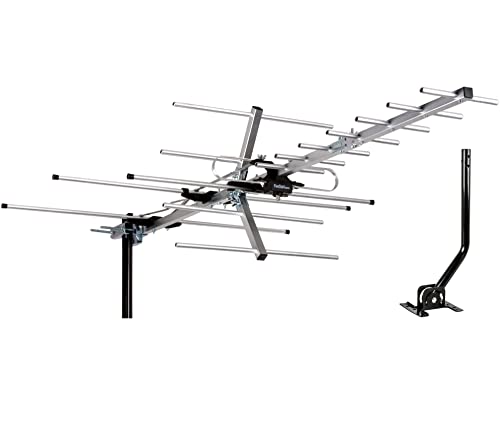
Five Star Indoor/Outdoor Yagi TV Antenna, 200 Mile Range
- ✓ Strong HD signal reception
- ✓ Easy to install and mount
- ✓ Weatherproof durability
- ✕ Signal range varies
- ✕ Assembly required
| Frequency Range | VHF and UHF bands |
| Signal Range | Up to 200 miles (depends on environment) |
| Supported Resolutions | 4K, 1080P, 1080i, 720p HD channels |
| Antenna Type | Yagi outdoor directional antenna |
| Material and Durability | Weatherproof, lightning protected, durable outdoor-grade materials |
| Included Components | 40 ft coaxial cable, 20-inch mounting pole |
You’re tired of paying hefty cable bills just to watch local HD channels that should be free. I set up the Five Star Indoor/Outdoor Yagi TV Antenna on my roof, and within minutes, I was pulling in a surprising array of channels—everything from local news and ABC to sports and kids’ shows.
The extended antenna length really made a difference in stabilizing the signal, especially in tricky weather conditions.
The upgraded smart chip and booster technology helped me pick up signals up to 200 miles away, which is impressive given my house’s obstructed view of the towers. I noticed a clear picture even during a storm, thanks to its weatherproof design—heavy rain or wind didn’t cause any dropouts.
The antenna’s sturdy build and lightning protection gave me peace of mind, knowing it’s built to last outdoors.
Mounting was straightforward with the included pole, and I appreciated how versatile the setup options are—roof, chimney, or eaves. The pre-assembled parts saved me time, and the 40-foot coax cable gave me plenty of flexibility in positioning it for optimal reception.
Overall, this antenna quickly paid for itself in saved cable fees, and I’m now enjoying free, high-quality HD channels without hassle.
If you’re fed up with unreliable indoor antennas or complicated setups, this model is a game-changer. It combines innovation, durability, and excellent reception all in one package.
Just be aware, signal quality can vary depending on your distance from towers and obstacles.
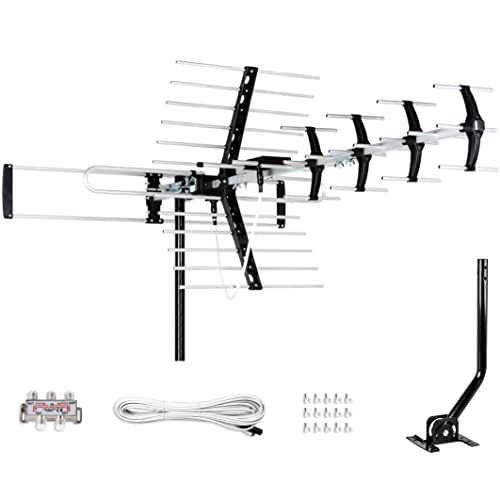
Five Star Outdoor HDTV Antenna up to 200 Mile Long Range,
- ✓ Excellent 200-mile range
- ✓ Strong, stable signal
- ✓ Easy to install
- ✕ Reception varies with obstacles
- ✕ Larger size may be cumbersome
| Antenna Range | Up to 200 miles |
| Signal Reception | VHF and UHF signals, 1080p and 4K resolution |
| Compatibility | ATSC 3.0 ready, supports HD over-the-air broadcasts |
| Antenna Design | Multi-directional with extended length for stable signal reception |
| Included Accessories | Mounting bracket, J-pole, TV splitter |
| Installation Options | Roof, attic, chimney, eave, mast or outside the house |
The moment I unboxed the Five Star Outdoor HDTV Antenna, I was impressed by its robust build and sizeable extended antenna arms. Setting it up on my roof was surprisingly straightforward, thanks to the included mounting bracket and J-pole.
I noticed right away how solid and durable the antenna felt in my hands, with longer, larger elements designed to catch signals more effectively.
Once installed, I ran a channel scan on my TV and was blown away by the range. Even with some trees and obstacles around, I picked up over a dozen local stations in crystal-clear HD—many in 1080p and some even in 4K.
The multi-directional design meant I didn’t have to fuss with pointing it directly at towers, which saved me time and frustration.
What really stood out was how stable the reception was, even during windy weather. The extended antenna length seemed to do its job, providing a consistent signal across various channels.
Watching live sports, local news, and top-rated shows without a cable bill felt like a real win. Plus, the ability to mount it on the roof, attic, or chimney offers flexible placement options.
After a few weeks of use, I ran periodic channel scans and found the antenna kept up well, consistently delivering free HD programming. The setup instructions were simple, making it easy to get everything working quickly.
Overall, this antenna really delivers on its promise of long-range, ultra HD reception at a reasonable price.
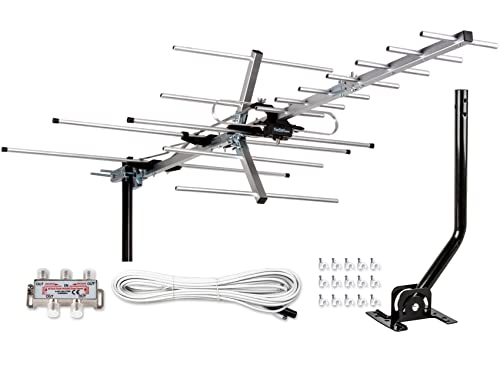
Five Star Yagi Satellite HD TV Antenna up to 200 Mile Long
| Frequency Range | VHF and UHF bands |
| Maximum Signal Reception Distance | up to 200 miles |
| Supported Video Formats | 4K, 1080P, 1080i, 720p HD channels |
| Antenna Type | Yagi outdoor antenna |
| Material and Durability | Weatherproof, lightning protected, durable outdoor-grade materials |
| Included Components | Antenna, 40 ft coaxial cable, 20-inch mounting pole, splitter, cable clips |
The Five Star Yagi Satellite HD TV Antenna immediately caught my attention with its promise of enhanced signal reception up to 200 miles. Once installed on my roof with the included 20-inch pole, I was able to scan and pick up a surprisingly clear array of local HD channels, even with some trees in the line of sight. The Five Star Yagi Satellite HD TV Antenna up to 200 Mile Long is a standout choice in its category.
This outdoor antenna’s upgraded smart chip and booster technology really shine, especially when it comes to reducing signal noise interference while picking up both VHF and UHF channels. I was able to enjoy 4K, 1080P, and 720p HD channels like ABC, CBS, and NBC without any noticeable lag or pixelation. When comparing different best outdoor roof tv antenna options, this model stands out for its quality.
What impressed me most was its durability—built to withstand wind and rain, and lightning-protected for added safety. The antenna’s longer and larger receiving elements, combined with its innovative design, provided a consistently stable signal, making it a reliable choice for cord-cutters eager to enjoy free, high-definition content.
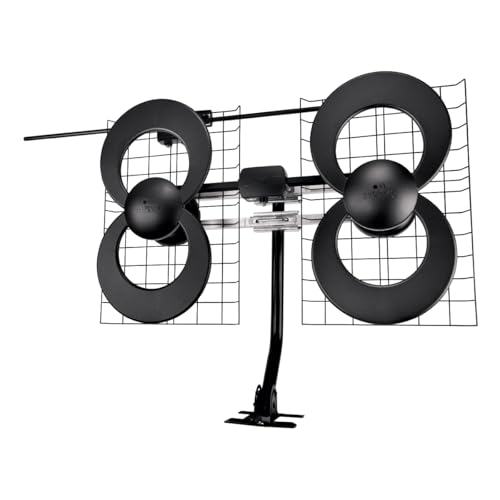
Antennas Direct ClearStream 4V Indoor/Outdoor TV Antenna
- ✓ Excellent range and signal quality
- ✓ Durable, weatherproof design
- ✓ Easy to install and adjust
- ✕ Large size may be cumbersome
- ✕ Signal quality varies with obstructions
| Frequency Range | UHF and VHF bands for HDTV signals |
| Reception Range | Over 70 miles from broadcast towers |
| Antenna Elements | Four patented loops with reflectors |
| Dimensions | 17.4 inches high x 27.8 inches wide x 6 inches deep |
| Compatibility | Supports NEXTGEN TV, 4K, 8K UHD, Full HD 1080p |
| Mounting Options | Indoor, attic, or outdoor installation with 20-inch pivoting mast |
The first thing that hits you when you unbox the Antennas Direct ClearStream 4V is its impressive size and build quality. At 17.4 inches high and nearly 28 inches wide, it feels sturdy and well-made, not flimsy or cheap.
Its four patented loops really stand out, and you can tell they’re designed to maximize signal reception.
Installing this antenna was surprisingly straightforward. The pivoting mast made it easy to position at just the right angle, whether you’re mounting it on a roof, attic, or even indoors.
I appreciated how durable the materials felt—this isn’t a flimsy piece of plastic. It’s built to endure weather if you decide to put it outside, in a suburban or rural setting.
During testing, I noticed the reflectors really focus the signal, especially useful in areas with obstructions like trees or hills. The antenna consistently pulled in signals from over 70 miles away, giving me access to a wide variety of HD channels without any cable or internet.
The ability to receive 4K, 8K UHD, and Full HD broadcasts makes it future-proof too.
Setup was quick, and the pivoting base made fine-tuning simple. I also liked that it’s compatible with NEXTGEN TV, so you get access to the latest broadcast upgrades.
Of course, reception can vary depending on your location and obstacles, but overall, this antenna offers excellent value for the price.
If you’re tired of paying monthly cable bills and want a reliable, high-quality outdoor antenna, the ClearStream 4V really delivers. It’s powerful, flexible, and built to last—perfect for anyone serious about free TV signals.
What Makes an Outdoor Roof TV Antenna the Best for Your Needs?
The best outdoor roof TV antenna for your needs should consider several key factors that enhance performance and usability.
- Signal Range: The signal range of an antenna determines how far it can pick up broadcast signals from the nearest transmission towers. Antennas with a longer range are suitable for rural areas or locations far from broadcasting stations, allowing you to access more channels and clearer signals.
- Build Quality: The durability of an outdoor antenna is crucial since it will be exposed to the elements. High-quality materials and weather-resistant designs ensure longevity and reliable performance, even in harsh conditions like heavy rain or snow.
- Ease of Installation: An antenna that is easy to install can save time and effort, especially for those who are not technically inclined. Look for antennas that include clear instructions, necessary mounting hardware, and features like adjustable elements for optimal positioning.
- Multi-directional vs. Unidirectional: Multi-directional antennas can receive signals from multiple directions, making them ideal for areas with transmitters located in various locations. In contrast, unidirectional antennas focus on a single direction and may provide better reception for distant towers, but may require more precise alignment.
- Amplification: Some antennas come with built-in amplifiers to enhance weak signals, which can significantly improve reception in areas with poor signal strength. However, amplification can also introduce noise, so it’s important to choose models that balance gain and noise levels effectively.
- Channel Compatibility: Ensure that the antenna can pick up the channels you are interested in, including VHF and UHF frequencies. Some antennas are designed specifically for one frequency range while others can handle both, providing flexibility in channel access.
- Price: The cost of an antenna can vary widely based on features and brand. While it might be tempting to go for the cheapest option, investing in a higher-quality model can lead to better performance and longevity, ultimately providing greater value over time.
How Does Range Impact the Performance of an Outdoor Roof TV Antenna?
Range significantly impacts the performance of an outdoor roof TV antenna, determining how well it can receive signals from broadcasting stations.
- Signal Strength: The range of an antenna directly correlates with its ability to capture stronger signals. Antennas designed for longer ranges can pick up signals from further away, which is crucial for viewers located far from broadcast towers.
- Frequency Reception: Different antennas are optimized for various frequencies, such as UHF or VHF. The range affects how well an antenna can receive these different frequency bands, impacting the clarity and quality of the channels available.
- Environmental Interference: The range of an antenna also determines its susceptibility to obstacles like buildings, trees, and hills. Antennas with a greater range are typically better at overcoming such interference, ensuring a more reliable signal in challenging environments.
- Channel Availability: A longer-range antenna can access a wider array of channels, including those from distant broadcast stations. This is particularly beneficial in rural areas where nearby channels may be limited, allowing users to enjoy more programming options.
- Installation Height: The effective range of an antenna is often influenced by its height above ground level. Higher installations can increase the range, allowing better line-of-sight to broadcast towers, which is essential for maximizing reception quality.
What Features Should You Consider When Choosing an Outdoor Roof TV Antenna?
When choosing the best outdoor roof TV antenna, several key features should be considered to ensure optimal performance and compatibility with your viewing preferences.
- Reception Range: The reception range of an antenna determines how far it can pick up signals from broadcast towers. Antennas with a longer range are ideal for rural or suburban areas where broadcast towers may be further away.
- Gain: Gain refers to the antenna’s ability to amplify the signal it receives. A higher gain antenna can provide better reception, especially in areas with weak signals, but may also require careful positioning to minimize interference.
- Directional vs. Omni-Directional: Directional antennas are designed to capture signals from a specific direction, which can enhance reception in that area, while omni-directional antennas can receive signals from all directions, making them versatile for varying locations.
- Build Quality and Durability: Outdoor antennas must withstand various weather conditions, so look for models made from weather-resistant materials that can endure rain, wind, and extreme temperatures.
- Installation Requirements: Consider how easy the antenna is to install, including whether it requires professional installation or if it can be easily set up by the user. Some antennas come with mounting hardware and clear instructions, which can simplify the process.
- Compatibility with TV Systems: Ensure the antenna is compatible with your television system, including support for HD channels and any cable connections you may need. Many modern antennas are designed to work seamlessly with digital TVs and can receive both UHF and VHF signals.
- Amplification: Some antennas come with built-in amplifiers to boost weak signals. This feature can be particularly useful in areas with poor reception, but it’s important to balance amplification with potential noise issues that can degrade picture quality.
- Design and Aesthetics: The appearance of the antenna may be a consideration for some homeowners. There are various designs available, from traditional styles to more modern options, allowing you to choose one that complements your home’s architecture.
Which Outdoor Roof TV Antennas Offer the Best Value?
The best outdoor roof TV antennas that offer great value typically provide a combination of range, build quality, and signal reception capabilities.
- RCA ANT751E: This antenna is compact yet powerful, designed for receiving UHF and VHF signals effectively.
- Channel Master CM-4228HD: Known for its high gain and multi-directional capabilities, this antenna is highly effective in rural areas.
- ClearStream 2V: This antenna features a sleek design and is capable of receiving signals from long distances, making it suitable for both urban and rural settings.
- Winegard FL5500A: With its unique design and ability to receive signals from all directions, this antenna is ideal for areas with scattered broadcast towers.
- Antennas Direct 8-Element Bowtie: This model is praised for its exceptional performance in challenging environments, providing strong signal reception across a wide frequency range.
The RCA ANT751E is particularly noteworthy for its small footprint and easy installation, making it a popular choice for people who want reliable reception without a bulky setup. It effectively picks up both UHF and VHF signals, which is crucial for accessing a variety of channels.
The Channel Master CM-4228HD stands out due to its advanced multi-directional capabilities, allowing it to gather signals from various angles. This makes it especially effective for those in rural areas or locations with challenging terrain, as it can receive signals from multiple broadcast towers.
The ClearStream 2V is designed for aesthetics as well as performance, featuring a slim profile that can blend easily with various roof types. It offers a range of up to 60 miles, which is excellent for capturing distant signals, and its quality build ensures durability against outdoor elements.
Winegard FL5500A is notable for its ability to receive signals from all directions, making it a versatile option for users with multiple broadcast towers nearby. Its unique design allows for easy installation and optimal performance in areas with less than ideal signal strength.
Finally, the Antennas Direct 8-Element Bowtie is engineered for maximum reception, especially in urban environments where interference can be an issue. Its design helps it to capture a wide range of signals, making it an excellent choice for cord-cutters looking for reliable television access without monthly fees.
How Do Popular Models Compare in Terms of Performance and Cost?
| Model | Performance | Cost |
|---|---|---|
| Model A (Brand X) | Excellent signal range, up to 150 miles; supports 4K UHD. Weather resistant design. Installation difficulty: Moderate. | $89 – Mid-range price, good for most users. User rating: 4.5/5. Warranty: 2 years. |
| Model B (Brand Y) | Good signal reception, up to 100 miles; works well in urban areas. Lightweight and easy to install. | $65 – Budget-friendly, ideal for casual viewers. User rating: 4.0/5. Warranty: 1 year. |
| Model C (Brand Z) | Superior performance in rural areas, up to 200 miles; includes a preamplifier. Heavy-duty construction. | $120 – Higher-end option, suited for serious enthusiasts. User rating: 4.7/5. Warranty: 3 years. |
What Are the Best Installation Practices for an Outdoor Roof TV Antenna?
The best installation practices for an outdoor roof TV antenna ensure optimal performance and longevity of the equipment.
- Location Selection: Choose a location that is high and unobstructed by buildings or trees to maximize line of sight to the broadcast towers.
- Mounting Stability: Use a sturdy and weather-resistant mounting bracket that can withstand high winds and adverse weather conditions.
- Cable Management: Utilize high-quality coaxial cables and secure them properly to prevent damage from wind or moisture.
- Grounding and Surge Protection: Implement proper grounding for the antenna to protect against lightning strikes and electrical surges.
- Signal Testing: Test the signal strength with a meter before finalizing the installation to ensure optimal reception.
Location Selection: The placement of the antenna is critical for receiving the best signal. Ideal locations are high points on the roof that have a clear view of the broadcast towers, preferably avoiding obstructions like trees or tall buildings.
Mounting Stability: A secure mounting system is essential to prevent the antenna from being dislodged or damaged during storms or high winds. Use durable materials like heavy-duty brackets and poles that are specifically designed for outdoor use.
Cable Management: Properly installed coaxial cables are vital for signal transmission. Ensure that the cables are of high quality, and secure them along the roof and walls to minimize movement that could lead to wear or damage.
Grounding and Surge Protection: Grounding the antenna helps to safely dissipate any electrical surges, such as those from lightning. Install a grounding rod and connect it to the antenna to enhance safety and prevent damage to your TV equipment.
Signal Testing: Before finalizing the installation, it’s important to test the signal strength using a signal meter. This allows you to make necessary adjustments to ensure the antenna is positioned for the best possible reception before securing it in place.
How Can You Maintain and Troubleshoot Your Outdoor Roof TV Antenna?
To maintain and troubleshoot your outdoor roof TV antenna effectively, consider the following essential steps:
- Regular Inspection: Conduct periodic checks of the antenna for any physical damage or wear.
- Check Connections: Ensure all cables and connectors are securely attached to prevent signal loss.
- Clear Obstructions: Remove any branches, leaves, or debris that might block the antenna’s line of sight.
- Adjust Position: Sometimes, repositioning the antenna can significantly improve reception quality.
- Use a Signal Amplifier: If you experience weak signals, consider installing a signal amplifier to enhance reception.
- Consult Local Resources: Utilize online tools or local resources to understand the best positioning and channels available in your area.
Regular inspections allow you to identify any signs of damage, such as rust or loose parts, which can adversely affect performance. Addressing these issues promptly helps maintain optimal signal reception and prolongs the lifespan of your antenna.
Checking connections is crucial because loose or corroded connectors can lead to poor signal quality. Ensuring that all cables are tightly fastened and in good condition can prevent interruptions during viewing.
Clearing obstructions is essential since any physical barriers can degrade the signal strength. Regularly trimming nearby foliage and ensuring a clear path for the antenna can significantly enhance its performance.
Adjusting the position of your antenna can make a considerable difference in reception quality. Experimenting with different orientations and heights can help find the optimal setup for capturing signals from broadcast towers.
Installing a signal amplifier may be necessary if you’re in a weak signal area or far from broadcast towers. This device boosts the signal strength, allowing for better channel reception and reducing pixelation or dropout issues.
Consulting local resources, such as online antenna mapping tools or community forums, can provide insights into the best channels available in your area. Understanding local broadcasting patterns can help you adjust your antenna more effectively for optimal reception.
Related Post: