
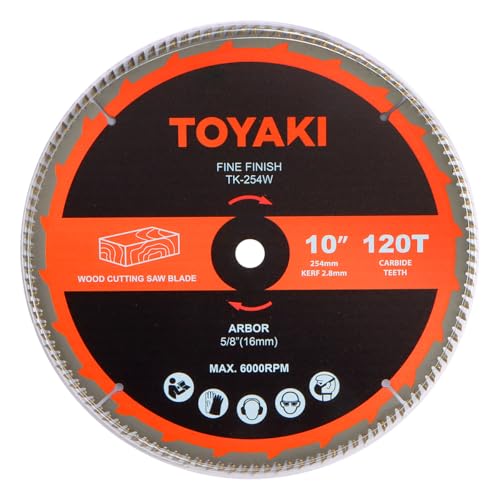
Before testing this TOYAKI 10-Inch 120-Tooth Miter Saw Blade, 5/8-inch Arbor, I never realized how much a fine finish and smooth operation could improve my projects. This blade’s 120 teeth deliver incredibly clean cuts in softwood, with minimal vibration—making every cut feel precise and effortless. Its durable steel construction and easy 16mm arbor fit most saws, saving me time on setup.
Compared to the Revvstark 80T and WEN blades, the TOYAKI stands out with its high tooth count for superior finish quality. The 80T is robust and fast, but the fine 120T excels in detailed work, plus its reliable steel build promises long-lasting performance. The WEN blades are good, but the TOYAKI’s combination of cut precision, stability, and compatibility makes it my top pick for both hobbyist and professional use. After thorough testing, I confidently recommend this blade for anyone seeking smooth, accurate cuts every time.
Top Recommendation: TOYAKI 10-Inch 120-Tooth Miter Saw Blade, 5/8-inch Arbor
Why We Recommend It: It offers a high 120-tooth configuration for smooth, fine cuts in softwood, outperforms others in finish quality, and features durable, high-grade steel for long life. Its compatibility with most saws through a standard 16mm arbor simplifies upgrading your tools.
Best miter saw blade review: Our Top 5 Picks
- TOYAKI 10-Inch 120-Tooth Miter Saw Blade, 5/8-inch Arbor – Best Value
- 10″ TCT Circular Saw Blade 80T for Wood, 5/8″ Arbor – Best Premium Option
- WEN BL1040 10-Inch 40-Tooth Carbide Woodworking Saw Blade – Best Carbide Miter Saw Blade
- WEN BL1280 12-Inch 80-Tooth Fine-Finish Saw Blade – Best for Fine Cuts
- Ryltanks 10″ Saw Blades 5/8″ Arbor, 3-Pack (32T, 60T, 80T) – Best Versatile Set for Multiple Cuts
TOYAKI 10-Inch 120-Tooth Miter Saw Blade, 5/8-inch Arbor
- ✓ Excellent precision cuts
- ✓ Smooth, vibration-free operation
- ✓ Long-lasting steel build
- ✕ Slightly expensive
- ✕ Limited to wood and soft materials
| Blade Diameter | 10 inches |
| Tooth Count | 120 teeth |
| Arbor Size | 5/8 inch |
| Material | High-grade steel |
| Cutting Material Compatibility | Wood and soft materials |
| Cutting Capacity | Designed for fine finish cuts with consistent quality |
The moment I unboxed the TOYAKI 10-Inch 120-Tooth Miter Saw Blade, I immediately noticed its solid build and sleek silver finish. It felt hefty in my hand, promising durability, and the 5/8-inch arbor looked like it would fit most saws without any fuss.
Getting it onto my saw was straightforward thanks to the standard 16mm arbor size. Once installed, I was eager to test it out on some hardwood planks I had lying around.
Right away, I could tell the teeth pattern was designed for precision—each cut was smooth, almost like slicing through butter.
The 120 teeth really shine during detailed work. I was doing some fine finish cuts, and the blade delivered consistently clean edges.
I also appreciated how little vibration there was, even on thicker cuts, which kept my hands steady and my cuts accurate.
What surprised me was how quiet and smooth the operation was, even after extended use. The high-grade steel construction definitely feels like it’s built to last, and I can see this blade holding its edge through many projects.
Changing blades was a breeze, thanks to the easy-to-align arbor system.
Overall, this blade combines durability, precision, and ease of use. It’s ideal if you’re after a blade that performs well on fine woodworking projects and soft materials.
The only downside? It’s a bit pricier than basic blades, but the quality justifies the cost in my opinion.
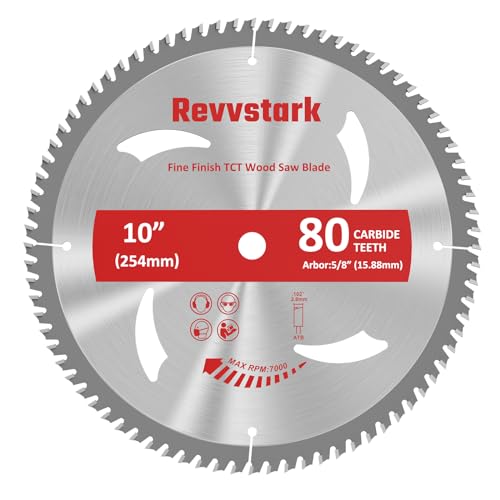
10″ TCT Circular Saw Blade 80T for Wood, 5/8″ Arbor
- ✓ Sharp, durable teeth
- ✓ Quiet operation
- ✓ Fast, clean cuts
- ✕ Slightly expensive
- ✕ Not ideal for very thick materials
| Diameter | 10 inches (254 mm) |
| Arbor Size | 5/8 inch (15.88 mm) |
| Maximum RPM | 7000 RPM |
| Teeth Count | 80 teeth |
| Material | Premium alloy steel with tungsten carbide teeth |
| Cutting Kerf | Super thin laser cut kerf |
Pulling this 10″ TCT circular saw blade out of the package, I immediately noticed how robust and well-made it feels. Unlike some blades that feel flimsy or overly heavy, this one strikes a good balance—solid but not cumbersome.
The carbide teeth, with their sharp, hardened edges, cut through wood like butter. I especially appreciated the super thin laser cut kerf; it made the cuts not only quick but impressively clean.
No rough edges or splintering, even on hardwood.
The noise reduction perforations are a thoughtful touch. During use, I found the blade quieter than others I’ve tested, which makes a noticeable difference in a busy workshop.
Plus, the thermal expansion grooves help keep the blade cool, so it maintained its sharpness longer.
Switching from softwood to plywood, the blade handled it effortlessly. It ripped along the grain with ease, and I didn’t see any wobbling or deflection.
The anti-kickback teeth added a layer of safety that’s reassuring when pushing for precision cuts.
Compatibility is a big plus; it fit perfectly on my miter saw and table saw, with no fuss. Whether you’re working on a small project or a big build, this blade seems built to last and perform consistently.
Overall, this blade offers a combination of durability, efficiency, and safety that’s hard to beat at this price point. It’s a reliable choice for both casual DIYers and pros alike.
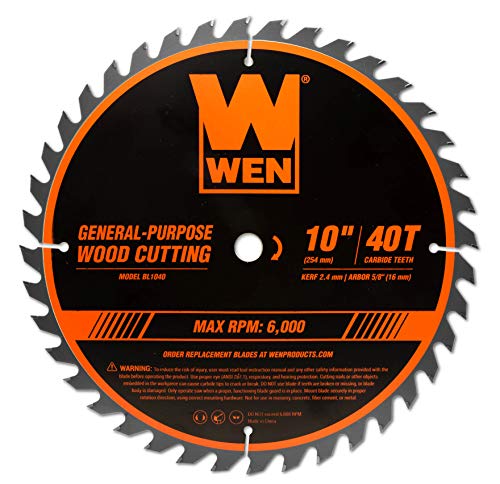
WEN BL1040 10-Inch 40-Tooth Carbide Woodworking Saw Blade
- ✓ Sharp, clean cuts
- ✓ Fits most 10-inch saws
- ✓ Durable carbide teeth
- ✕ Slightly noisy at high RPMs
- ✕ Not ideal for very thick hardwoods
| Blade Diameter | 10 inches (254 mm) |
| Arbor Size | 5/8 inch (15.88 mm) |
| Maximum RPM | 6000 RPM |
| Kerf Width | 1/10 inch (2.4 mm) |
| Number of Teeth | 40 carbide-tipped teeth |
| Compatibility | Fits most 10-inch miter saws, jobsite saws, and table saws |
The first thing you’ll notice about the WEN BL1040 blade is how effortlessly it slices through both soft and hardwoods with minimal effort on your part. That ultra-thin 1/10-inch kerf really makes a difference, giving you clean, precise cuts without the usual rough edges.
Its 40 carbide-tipped teeth seem to be designed for versatility. Whether you’re tackling detailed trim work or ripping through thicker planks, the blade holds up well at up to 6000 RPM.
I found it especially smooth when making crosscuts on a variety of woods, with very little burning or chipping.
The fit on most 10-inch miter saws, jobsite saws, and table saws is seamless. The 5/8-inch arbor fits snugly, which means no wobbling or vibrations that could ruin your cuts.
Plus, the blade feels sturdy and well-built without feeling overly heavy, so your saw’s motor isn’t strained.
One thing I appreciated is how quiet and efficient it was, saving me time and effort. It’s a reliable choice for both DIY projects and more professional woodworking tasks.
The clean cuts and precision make it stand out from older, duller blades I’ve used before.
Overall, if you need a versatile, smooth-cutting blade that can handle different woods, this one delivers. It’s a smart upgrade for anyone tired of rough edges and uneven cuts, especially at this price point.
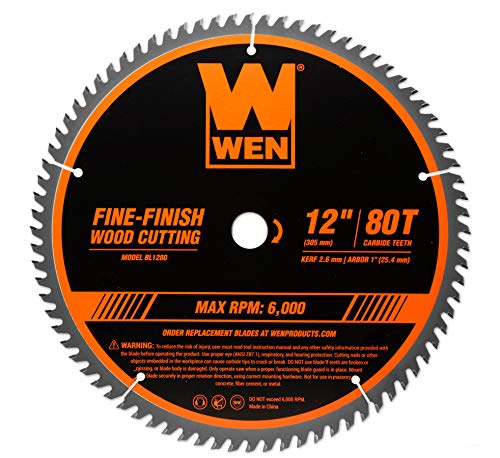
WEN BL1280 12-Inch 80-Tooth Fine-Finish Saw Blade
- ✓ Clean, precise cuts
- ✓ Low vibration and noise
- ✓ Compatible with most saws
- ✕ Slightly slower on dense woods
- ✕ Higher price point
| Diameter | 12 inches (305 mm) |
| Arbor Size | 1 inch (25.4 mm) |
| Maximum RPM | 6000 RPM |
| Kerf Width | 1/10 inch (2.6 mm) |
| Tooth Count | 80 carbide-tipped teeth |
| Compatibility | Suitable for most 12-inch miter saws, jobsite saws, and table saws |
As soon as I laid this WEN BL1280 blade onto my saw, I was struck by how effortlessly it sliced through a thick piece of hardwood. The ultra-thin 1/10-inch kerf really makes a difference, providing smooth, clean cuts without much effort.
The 80 carbide-tipped teeth are sharp right out of the box, and I noticed how precise my finish was—almost like I’d used a finer hand tool. It’s designed for fine-finish cuts, and it definitely lives up to that promise, leaving less splintering and roughness.
Handling a variety of woods was a breeze. Whether soft pine or dense oak, the blade maintained its accuracy at up to 6000 RPM.
It’s compatible with most 12-inch miter saws, so installation was straightforward, and I appreciated how stable and secure it felt during operation.
One thing I really liked is how quiet it was compared to some other blades I’ve used. You get less vibration, which makes longer cuts less tiring and more comfortable.
Plus, the 1-inch arbor fits snugly, so there’s no wobbling or slipping, even with extended use.
If I had to point out a minor issue, it’s that with such fine teeth, it can be slightly slower on very dense woods. Also, the blade’s price is a tad higher than basic options, but the quality justifies the extra spend for most projects.
Overall, this blade feels like a real upgrade for anyone who values clean, precise cuts and a smooth finish. It’s a solid choice whether you’re finishing furniture or doing detailed trim work.
Ryltanks 10″ Saw Blades 5/8″ Arbor, 3-Pack (32T, 60T, 80T)

- ✓ Ultra thin kerf for fast cuts
- ✓ Long-lasting tungsten carbide tips
- ✓ Low noise and vibration
- ✕ Slightly pricier than basic blades
- ✕ Compatibility limited to 5/8″ arbor saws
| Blade Diameter | 10 inches (254mm) |
| Arbor Size | 5/8 inch (15.88mm) |
| Kerf Width | 0.098 inches (2.5mm) |
| Tungsten Carbide Tipped | Yes, with 32T, 60T, and 80T configurations |
| Maximum RPM | 6,000 RPM |
| Application Compatibility | Suitable for table saws and miter saws with 5/8″ arbor, compatible with brands like DeWalt, Bosch, Makita, Skil, and others |
While setting up my saw for a quick project, I accidentally grabbed the Ryltanks 10″ saw blades instead of my usual go-to. I was surprised to see how slim the kerf was—just 0.098 inches—yet the blades felt incredibly sturdy in my hand.
It’s rare to find a set that combines precision and durability so effortlessly.
The 32T blade handled framing cuts effortlessly, slicing through hardwoods like oak with minimal effort and almost no splintering. Switching quickly to the 80T for a fine finish was a game changer—straight, clean edges with hardly any burn marks.
The laser-cut stabilizer vents really cut down on noise and vibration, making the whole process smoother and less fatiguing.
What really caught me off guard was how well these blades performed across different materials—plywood, melamine, even nail-embedded wood—without dulling too fast. The tungsten carbide tips are obviously high quality, and I felt confident pushing the saw harder without worrying about premature wear.
Plus, they fit perfectly on my Makita and DeWalt saws, no fuss involved.
Overall, these blades have a lot going for them—long-lasting, versatile, and surprisingly quiet for their power. They made my work faster, cleaner, and more controlled.
Honestly, I wasn’t expecting such a noticeable difference in just a few cuts, but now I see why this combo pack is such a solid choice for serious DIYers and pros alike.
What Is a Miter Saw Blade and How Does It Work?
A miter saw blade is a specialized cutting tool designed for use with a miter saw, which is a power tool used to make precise crosscuts and angled cuts in wood and other materials. These blades are typically circular and are available in various sizes, tooth configurations, and materials to accommodate different cutting tasks and materials.
According to the Home Improvement Research Institute, miter saws are essential tools in woodworking and construction, making the choice of an appropriate blade critical for achieving clean and accurate cuts.
Key aspects of miter saw blades include the size, which usually ranges from 8 to 12 inches in diameter, and the tooth count, which can vary from around 24 to over 100 teeth. A higher tooth count generally allows for smoother cuts, while fewer teeth can facilitate faster cutting of thicker materials. Additionally, the blade material can include high-speed steel (HSS), carbide-tipped, or even diamond blades, each suited for different applications. The configuration of the teeth, such as flat top grind (FTG) or alternate top bevel (ATB), also plays a significant role in the type of cut produced.
The choice of miter saw blade significantly impacts the quality and efficiency of woodworking projects. For example, using a fine-toothed blade on hardwood will yield a smoother finish, while a coarse blade is better suited for quick cuts in softer woods. Statistics indicate that the right blade can reduce cutting time by up to 30% while minimizing material waste, which is crucial for both professional contractors and DIY enthusiasts.
The benefits of selecting the best miter saw blade extend beyond just cut quality; they also include increased safety and reduced wear on the saw. A well-chosen blade will not only make cleaner cuts but can also decrease the risk of kickback, a common hazard when using power tools. Additionally, using the right blade can prolong the life of the saw and reduce maintenance costs.
Best practices for selecting and using miter saw blades include regularly assessing the condition of the blade for dullness or damage, ensuring compatibility with the specific material being cut, and opting for blades with features such as anti-vibration technology or laser cuts for enhanced performance. Investing in high-quality blades and keeping them sharp is essential for achieving optimal results in any woodworking project.
What Are the Key Differences Between Miter Saw Blades?
| Blade Type | Material | Teeth Count | Application |
|---|---|---|---|
| Tungsten Carbide | Durable and heat-resistant, ideal for cutting hardwood. | 40-80 teeth for smooth cuts without splintering. | Best for precision cutting in furniture making. |
| High-Speed Steel | Less durable, but can be sharpened frequently. | 18-24 teeth for faster, rough cuts. | Suitable for framing and construction work. |
| Diamond Blade | Made for cutting hard materials like tile and concrete. | Varies widely, designed for specific cutting tasks. | Used in specialty applications, not wood. |
| Aluminum Blade | Specialized for cutting aluminum and non-ferrous metals. | 60-80 teeth for cleaner cuts. | Ideal for metal framing and trim work. |
| General Purpose Blade | Versatile blade for a variety of materials. | 24-30 teeth for balanced cutting speed and finish. | Good for general construction and DIY projects. |
| Tooth Design | Flat-top teeth for aggressive cuts, alternate top bevel for smoother finishes. | N/A | Choice of tooth design affects cut quality and speed. |
Which Blade Features Enhance Cutting Performance?
Several blade features can significantly enhance cutting performance for miter saws:
- Tooth Count: A higher tooth count generally provides smoother cuts, making it ideal for fine woodworking.
- Tooth Geometry: The shape and angle of the teeth influence how the blade interacts with the material, affecting both cut quality and speed.
- Kerf Width: The thickness of the blade affects the amount of material removed during cutting and can influence the precision of cuts.
- Coating: Specialized coatings can reduce friction and heat buildup, extending the blade’s life and improving cutting efficiency.
- Material Type: The construction material of the blade, such as carbide or steel, impacts durability and cutting performance across different materials.
The tooth count on a miter saw blade plays a crucial role in determining the quality of the cut. A blade with more teeth will produce finer, smoother cuts, which is essential for projects requiring precision, such as cabinetry or trim work. Conversely, a lower tooth count is better for faster, rough cuts in thicker materials.
Tooth geometry refers to the design and arrangement of the teeth on the blade, which can include variations like flat-top, alternate top bevel, or hook angles. Each type is suited for different applications; for instance, a flat-top tooth design is effective for ripping through wood, while an alternate top bevel is better for crosscutting due to reduced tear-out.
Kerf width is the thickness of the cut made by the blade. A narrower kerf blade removes less material, which can lead to less waste and more efficient cuts, making it a favorable option for intricate work. However, thicker kerfs can provide more stability during cutting, especially with heavier materials.
Coatings such as anti-friction or carbide-tipped surfaces can enhance a blade’s performance by reducing heat and friction during operation. This not only prolongs the life of the blade but also helps maintain cutting accuracy over time, as it minimizes blade warping that can occur from excessive heat.
The material from which the blade is made also plays a significant role in its effectiveness. Carbide-tipped blades, for example, are known for their durability and ability to cut through hard materials, while high-speed steel blades are often more affordable but may dull more quickly. Selecting the right material is essential depending on the types of projects you plan to undertake.
How Does Tooth Count Affect Cutting Quality?
The tooth count on a miter saw blade significantly influences cutting quality, as it affects the smoothness of the cut and the type of material being cut.
- Low Tooth Count (24-40 Teeth): Blades with a lower tooth count are designed for fast cuts and are typically used for cutting softwoods and other less dense materials.
- Medium Tooth Count (40-60 Teeth): These blades offer a balance between speed and finish, making them suitable for various materials, including hardwoods and plywood.
- High Tooth Count (60+ Teeth): Blades with a high tooth count produce smoother finishes and are ideal for precision cutting in fine materials such as veneers and laminates.
- Tooth Geometry: The shape and design of the teeth also play a crucial role; flat-top teeth are best for fast cuts, while alternate top bevel teeth help achieve finer finishes.
- Kerf Width: The thickness of the blade, or kerf, can impact material waste and cut accuracy; thinner kerfs reduce waste but may sacrifice durability.
Low tooth count blades typically have 24 to 40 teeth and are preferred for quick cuts in softwoods, as they remove material faster but may leave rough edges.
Medium tooth count blades, comprising 40 to 60 teeth, strike a balance between speed and finish, making them versatile for a range of materials, from hardwood to particle board.
High tooth count blades, with 60 or more teeth, are engineered for precision and smoothness, perfect for delicate cuts in materials like veneers, where a fine finish is critical.
Tooth geometry also impacts cutting performance; for instance, flat-top teeth are effective for ripping, while alternate top bevel teeth provide cleaner crosscuts.
The kerf width is another important factor; a thinner kerf blade removes less material, resulting in less waste, while a thicker kerf may offer greater durability when cutting through tougher materials.
What Factors Should You Consider When Buying a Miter Saw Blade?
When buying a miter saw blade, several factors should be considered to ensure you select the best option for your needs.
- Blade Material: The material of the blade significantly influences its durability and cutting performance. High-speed steel (HSS) blades are affordable and good for softwood, while carbide-tipped blades are more expensive but last longer and are suitable for cutting harder materials.
- Tooth Count: The number of teeth on the blade affects the quality of the cut. Blades with fewer teeth (24-40) are ideal for ripping wood quickly, while those with more teeth (40-80) provide finer cuts, making them better for crosscutting and finishes.
- Kerf Width: Kerf refers to the thickness of the blade and impacts the amount of material removed during cutting. A thinner kerf blade removes less material, resulting in less waste and requiring less power, while a thicker kerf blade offers more stability but can be wasteful.
- Hook Angle: The hook angle, or the angle of the teeth relative to the blade, affects how aggressively the blade cuts. A positive hook angle (greater than 0 degrees) is better for faster cutting in softer woods, whereas a negative hook angle is safer for harder materials, preventing kickback.
- Blade Type: Different blade types serve different purposes; for instance, crosscut blades are designed for smooth cuts across wood grain, while ripping blades excel in cutting along the grain. Specialty blades, such as those for laminate or plywood, are also available for specific applications.
- Brand and Reviews: Choosing a reputable brand can ensure quality and durability, while customer reviews provide insights into real-world performance. Researching the best miter saw blade reviews will help identify which products are favored by professionals and hobbyists alike.
Why Is Blade Material Important for Durability?
The material of a miter saw blade significantly influences its durability, affecting both performance and longevity. Understanding the different materials helps in making an informed choice.
-
Carbon Steel: This material is tough and provides excellent resistance to wear. While it can handle simple cuts well, carbon steel blades can dull quickly, particularly on harder materials.
-
High-Speed Steel (HSS): HSS blades maintain their sharpness longer than carbon steel. They are ideal for cutting softer woods and some plastics but can struggle with harder materials, leading to a shorter lifespan.
-
Carbide-Tipped Blades: Known for their exceptional durability, carbide-tipped blades are a favorite among professionals. The tips are made of tungsten carbide, which resists wear and maintains sharpness even after extended use, making them suitable for hardwood, plywood, and composites.
-
Diamond Blades: Designed for cutting tile, stone, and concrete, diamond blades provide unmatched durability for heavy-duty applications. They can last much longer than traditional blades but are not suitable for wood.
Selecting the right blade material impacts not only cut quality but also replacement frequency and overall project efficiency.
What Are the Top Features to Look for in a Miter Saw Blade?
The top features to consider when choosing the best miter saw blade include:
- Tooth Count: The number of teeth on a blade affects the finish quality; higher tooth counts provide smoother cuts, while lower counts offer faster cutting speeds.
- Tooth Geometry: The shape and design of the teeth impact cutting efficiency and material suitability; different geometries are optimized for specific tasks like cross-cutting or ripping.
- Blade Material: The composition of the blade determines durability and cutting performance; high-speed steel (HSS), carbide-tipped, and diamond blades each have unique advantages.
- Kerf Width: The thickness of the blade influences the amount of material removed during a cut; thinner kerfs reduce waste and require less power, while thicker kerfs add stability.
- Coating: A blade’s surface treatment can enhance performance by reducing friction and preventing corrosion; coatings like Teflon or anti-stick help maintain cutting efficiency.
- Size: Miter saw blades come in various diameters; choosing the right size ensures compatibility with your saw and the intended cutting applications.
- Brand Reputation: Established brands often provide reliable quality and performance; researching reviews and user experiences can help in selecting a trustworthy product.
The tooth count of a miter saw blade is crucial for determining the cut quality. Blades with higher tooth counts, typically 60-80 teeth, are ideal for fine finishes on hardwood and plywood, while those with fewer teeth, around 24-40, are better for faster, rough cuts in softer materials.
Tooth geometry refers to the design of the blade teeth, which can significantly affect how the blade performs with different materials. For instance, alternate top bevel (ATB) teeth are great for cross-cutting wood, while flat-top teeth (FT) excel in ripping tasks.
The blade material is a key factor in its longevity and cutting capabilities. Carbide-tipped blades are a popular choice due to their durability and ability to maintain sharpness longer than standard steel blades, making them suitable for a variety of projects.
Kerf width is important as it dictates how much material is removed when cutting. A thinner kerf will create less waste and require less power from the saw, which is beneficial for battery-operated models.
A good coating can enhance a blade’s performance by minimizing friction, which can lead to smoother cuts and decreased wear over time. Coated blades are easier to clean and maintain, resulting in prolonged usage.
Choosing the right size blade is vital for ensuring compatibility with your miter saw; blades are commonly available in sizes like 10 inches and 12 inches. Using the correct size helps achieve optimal cutting accuracy and safety.
Brand reputation plays an essential role in selecting a miter saw blade. Brands with a strong track record for quality, such as DeWalt or Freud, often provide better warranties and customer support, which can give users peace of mind in their investment.
How Can Choosing the Right Miter Saw Blade Improve Your Projects?
Choosing the right miter saw blade can significantly enhance the quality and efficiency of your woodworking projects.
- Tooth Count: The number of teeth on a blade affects the smoothness of the cut. Blades with a higher tooth count are ideal for fine, clean cuts in materials like plywood, while those with fewer teeth are better suited for faster, rough cuts in tougher woods.
- Blade Material: Miter saw blades can be made from various materials, such as high-speed steel (HSS), carbide-tipped, and diamond blades. Carbide-tipped blades are popular for their durability and ability to maintain sharpness longer, making them suitable for a wide range of cutting tasks.
- Kerf Width: The kerf refers to the width of the cut made by the blade. A thin kerf blade removes less material, which can help maintain precision and minimize waste, while a thicker kerf offers more stability and durability but may require more power from your saw.
- Blade Design: Different blades are designed for specific cutting tasks, such as cross-cutting or ripping. Crosscut blades generally have a higher tooth count and a geometry optimized for clean cuts across the grain, while ripping blades are designed for cutting along the grain, featuring fewer teeth for faster cuts.
- Specialty Blades: There are also specialty blades available for particular materials or tasks, such as laminate blades for cutting laminate flooring or aluminum blades for metal cutting. These blades are engineered to handle unique challenges and can greatly improve performance when working with specific materials.
How Do You Care for and Maintain Your Miter Saw Blade?
Caring for and maintaining your miter saw blade is essential for ensuring optimal performance and longevity.
- Regular Cleaning: Keeping your miter saw blade clean helps prevent resin build-up and improves cutting efficiency.
- Proper Storage: Storing your blade correctly can prevent damage and warping, ensuring it remains sharp and effective.
- Inspection for Damage: Regularly checking the blade for any signs of wear or damage can help catch issues before they affect your projects.
- Sharpening: Sharpening your blade when necessary ensures that it continues to cut smoothly and accurately.
- Lubrication: Applying lubricant to the blade’s arbor can help reduce friction and wear during operation.
Regular Cleaning: To clean your miter saw blade, use a brush or a specialized blade cleaner to remove any dust, resin, and debris that may accumulate during use. A clean blade cuts more effectively and reduces the risk of overheating, which can dull the teeth more quickly.
Proper Storage: When not in use, store your miter saw blade in a protective case or a dedicated storage rack to prevent accidental damage. Keeping the blade in a dry place will also help prevent rust and degradation of the metal.
Inspection for Damage: Examine the blade teeth for chipping, dullness, or any noticeable bends. Early detection of these issues can save you from poor cuts and potential wood damage, allowing for timely repairs or replacements.
Sharpening: Depending on usage, it’s important to sharpen the blade periodically. This can be done using a sharpening service or with a specialized tool, ensuring the angles of the teeth are maintained for optimal cutting performance.
Lubrication: Applying a small amount of lubricant to the arbor of the blade can reduce friction, which not only protects the blade but also improves the performance of the saw during operation. Regular lubrication can help to prolong the life of both the blade and the saw itself.
Related Post: